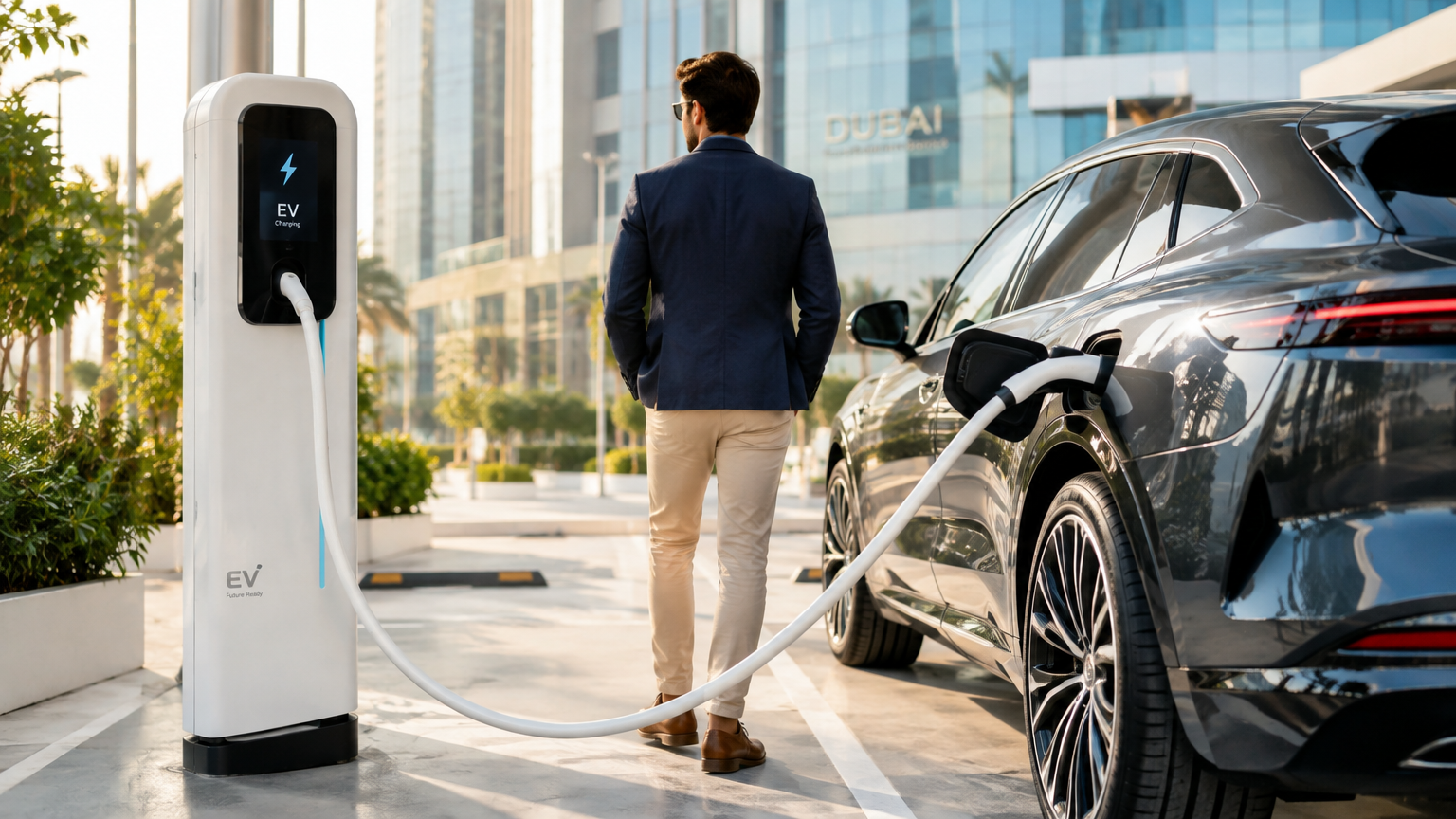
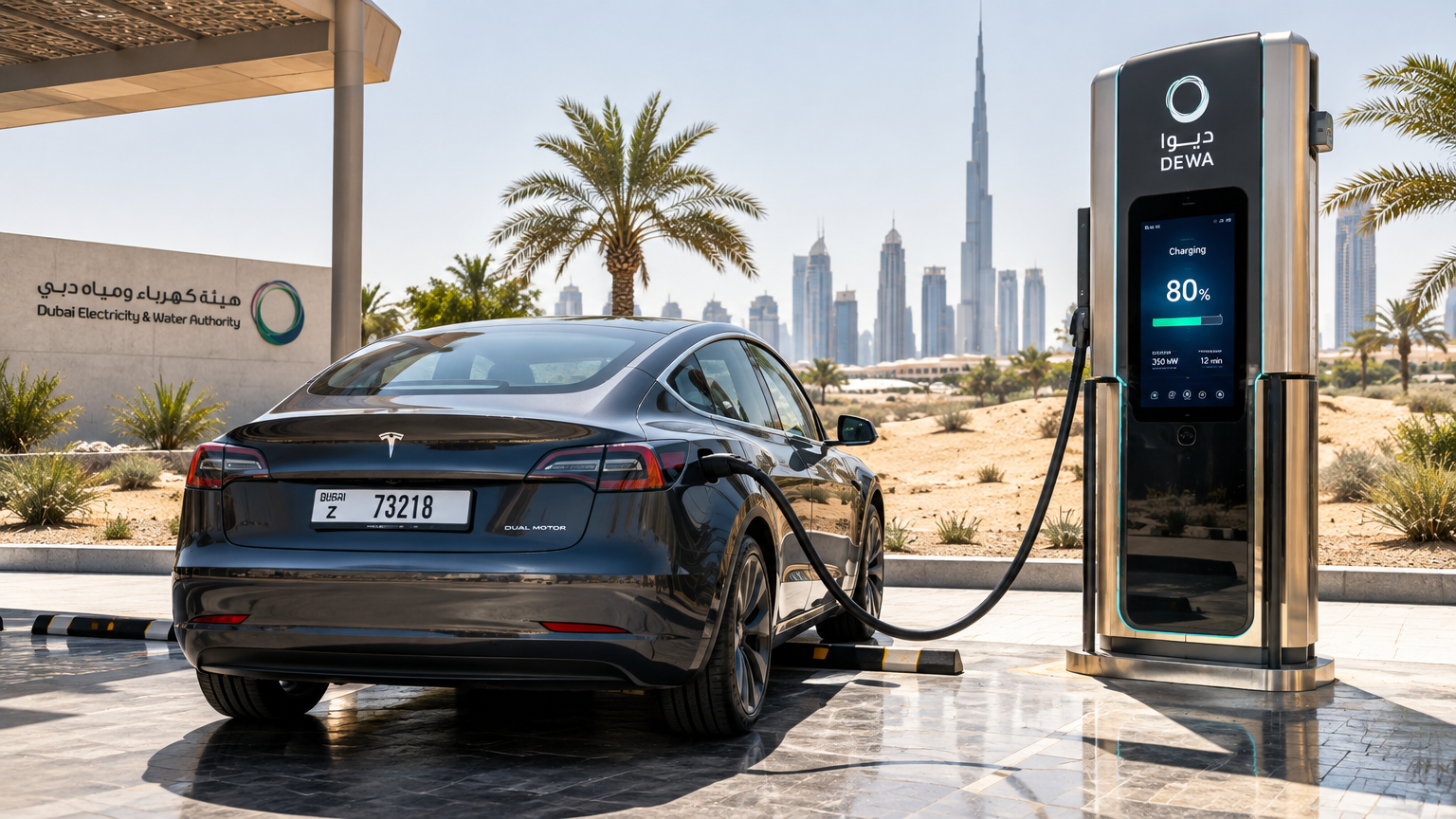
Dubai’s EV charging landscape is expanding rapidly, but many owners make costly mistakes. This guide covers the biggest EV charging Dubai mistakes to avoid — from relying on a single network to ignoring local regulations. Learn practical solutions tailored to Dubai’s power tariffs, climate, and compliance rules so you can charge efficiently and legally.
Quick Summary
Five common mistakes Dubai EV owners make: relying solely on the DEWA Green Charger app, picking the wrong charger type, skipping NOC/permits for home installations, underestimating heat-related range loss, and paying peak rates by charging at bad times.
Why it matters: each mistake adds cost, time, or risk — all avoidable with proper planning.
What you’ll learn: practical solutions specific to Dubai’s power tariffs, regulations (DEWA, Dubai Building Code, RTA), climate, and network options.
How you’ll be ready to act: confidently choose a charger, schedule charging, avoid legal issues, and reduce operating expenses.
Dubai’s EV-Charging Ecosystem in 2026
Dubai’s EV charging network is growing fast. DEWA’s EV Green Charger initiative now operates over 400 public chargers. Private operators like ENOC EVgo, UAEV, and ADNOC e-Tap are expanding their networks across the emirate.
You’ll encounter multiple connector types: Type 2, CCS2, and some GB/T (Chinese standard). Understanding which one your vehicle uses is essential.
Current pricing: AC charging costs AED 0.70/kWh plus VAT, while DC fast charging runs AED 1.20/kWh plus VAT under DEWA’s tariff structure.
Strict regulations apply to both public and private chargers. The DEWA EV Charging Technical Regulations (version 1.0, May 2025) set design criteria, connector types, temperature limits, and installation approvals. All EVSE (Electric Vehicle Supply Equipment) must comply.
Top 5 EV Charging Dubai Mistakes & How to Fix Them
Here are the most common errors owners make—and exactly how to avoid them.
Mistake #1: Relying Only on the DEWA Green Charger App
What happens: You plan routes assuming the DEWA Green Charger network will always have available chargers with the right connector type for your vehicle.
Why it hurts:
Chargers may be in use, out of service, or unavailable in your area.
You end up paying more at private stations or waiting longer.
Network gaps exist in areas like Jebel Ali and the outskirts.
Dubai-specific reality: While DEWA has expanded to over 1,000 outlets, third-party networks like ADNOC e-Tap and EVgo are quickly filling gaps—especially fast chargers on highway routes and at ENOC stations.
The fix:
Install multiple charging apps. Beyond DEWA EV Green Charger, add ENOC EVgo, UAEV, and ADNOC e-Tap. Keep them updated for real-time availability and mapping.
Install a home charger as backup. Even with plentiful public charging, home charging overnight covers your daily miles and reduces public network dependency.
Check connector compatibility. If your car uses GB/T (Chinese standard), you’ll need an adapter. Most UAE public networks use CCS2 or Type 2.
Mistake #2: Choosing the Wrong Charger Type
What happens: You install a powerful charger (say, 22 kW AC or high-power DC) only to discover your vehicle’s onboard charger limits it to 7 kW AC, or your battery cannot safely handle fast DC charging.
Why it hurts:
You overspend on a charger that won’t deliver faster charging.
Risk of overheating and premature battery degradation.
Poor performance during Dubai’s intense summer heat.
DEWA’s requirements: Public chargers must use Type-2 (AC) and CCS2 (DC). Private installations can use other connectors if approved by DEWA. Importantly, charger performance is limited by ambient conditions—above 55°C, performance drops significantly.
The fix:
Check your vehicle’s specifications first. Look up your EV’s maximum AC and DC charging inputs. If your onboard charger accepts only 7 kW, a 22 kW wall box won’t speed things up.
Match charger type to your routine. Local driving around Downtown, Business Bay, or Marina? A 7–11 kW AC charger may be perfect. For cross-emirate travel or desert trips, prioritize DC fast-charging access.
Use DEWA-approved equipment and installers. This ensures your system is safe, efficient, and fully compliant with technical regulations.
Mistake #3: Skipping NOC and Permits for Home Installation
What happens: Homeowners or apartment dwellers begin installing home chargers without obtaining a No Objection Certificate (NOC) or approvals from building management, DEWA, Dubai Municipality, or property owners.
Why it hurts:
DEWA or building management can disable or remove your charger.
You face potential fines, delays, or forced removal.
Dubai’s legal framework:
Directive No. 1 of 2017 requires DEWA approval for any EV charging station, public or private.
Dubai Building Code, Part G.5.2, mandates prior DEWA approval, a dedicated circuit, proper ventilation space, and correct connector and mode.
The fix:
Hire a DEWA-approved contractor or electrician. They understand all requirements and can navigate the approval process.
Obtain NOC from building management (for apartments), then submit your application to DEWA. Villa owners usually have a simpler process unless adding significant electrical load.
Verify your building’s load capacity. If your total electrical draw is too high, DEWA may require a service upgrade or charger current limitation.
Mistake #4: Underestimating Summer Heat Impact on Range
What happens: You assume advertised range—300–450 km—is realistic even when summer temperatures hit 40–50°C and air conditioning runs constantly.
Why it hurts:
You run out of charge unexpectedly.
You’re forced into expensive DC charging sessions.
Battery stress accelerates degradation.
Real Dubai data: On typical summer days above 38°C, range loss from cooling demand and battery inefficiencies can reach 25–30% or higher. Vehicles with better liquid-cooling systems perform better than those with air cooling.
The fix:
Plan using realistic range, not maximum claimed range. If you typically use 80% of battery and subtract an additional 25–30%, calculate what you genuinely need between charge stops.
Charge during cooler parts of the day. Evening or early morning charging starts your battery cooler. Park in shade or covered areas when possible.
Pre-condition your cabin while still plugged in. Many EVs let you use grid power for AC cooling before departure, preserving battery energy.
Mistake #5: Charging During Peak Hours Without Scheduling
What happens: You plug in as soon as you arrive home in the evening—often during higher DEWA tariff periods. Equipment works harder, efficiency drops, and your electricity bill climbs.
Why it hurts:
Your monthly electricity bill increases noticeably.
Chargers and wiring generate excess heat under peak loads.
Charging is slower when the grid is stressed.
DEWA’s tariff structure: Residential customers pay AED 0.230/kWh for the first 2,000 kWh monthly, then AED 0.280/kWh for usage between 2,001–4,000 kWh, with higher rates above that. Summer peak hours (12pm–6pm, June–September) add strain to the grid and your costs.
The fix:
Set chargers to auto-schedule overnight or off-peak hours (roughly 10pm–7am) for lower rates and cooler operating temperatures.
Monitor your consumption slabs. Try to stay within lower slabs by spreading usage across the month.
Use smart chargers with timers and current limiting. Remote-start features let you charge during the cheapest windows automatically.
Comparison Table: Mistakes and Solutions
Mistake
Impact
Solution
Relying only on DEWA Green Charger
Downtime, coverage gaps, wrong connectors, wasted time and money
Install multiple network apps; verify plug compatibility; have home charger backup
Wrong charger type or overspecification
Wasted investment, no speed gain, battery and cooling stress
Match charger power to vehicle specs; use DEWA-approved EVSE; understand onboard charger limits
Skipping NOC and approvals
Charger removal, safety hazards, fines, liability
Get building consent; obtain DEWA approval; hire DEWA-approved contractors; verify electrical load
Underestimating summer range loss
Range anxiety, unplanned expensive charging, battery stress
Use realistic range estimates; charge during cooler hours; precondition cabin; account for AC load
Understanding Dubai’s regulatory environment is essential for trouble-free EV charging.
DEWA EV Charging Technical Regulations (v1.0, May 2025) define design standards for all chargers, including connector types (Type-2 for AC, CCS2 for DC on public networks), safety protocols, ambient temperature limits, and humidity requirements.
Dubai Building Code, Section G.5.2, specifies requirements for private EVSE installations, including NOC requirements, dedicated circuits, ventilation, permitted charging modes, and physical space standards.
Directive No. 1 of 2017 by the Supreme Council of Energy mandates that all organizations installing EV charging infrastructure obtain approvals from DEWA and coordinate with RTA and Dubai Municipality.
Frequently Asked Questions
Do I need DEWA approval for a home charger in my villa?
Yes. Even villas require DEWA approval if your charger installation increases the electrical load beyond your meter’s capacity. Work with a DEWA-approved contractor to ensure compliance with technical regulations. Apartment dwellers also need building management and owners’ association consent.
Can I rely solely on DEWA Green Charger stations?
Technically yes, but it’s risky. Signing up with private networks like ADNOC e-Tap or EVgo provides backup access when DEWA chargers are busy or out of service—and they often have faster DC chargers on highways between emirates.
How much range do I lose in summer around Dubai Marina?
Real-world testing shows 25–30% or greater range loss on days above 38–40°C with heavy air conditioning use. Hill driving, highway speeds, and stop-start traffic in malls make it worse. Always leave a safety margin in your trip planning.
What’s the cheapest time to charge at home?
Overnight or early morning (approximately 10pm–7am) offers the lowest rates and coolest operating temperatures. Avoid afternoon hours (12pm–6pm), especially in summer. Also monitor your monthly consumption slab to prevent higher per-kWh rates.
How do I know if my EV supports DC fast charging?
Check your vehicle’s technical specifications for AC and DC charging inputs and connector types. Look for a CCS2 port, which indicates DC capability. Vehicles from China may use GB/T connectors and require an adapter, as UAE public DC networks primarily support CCS2.
Take Action Today
You now understand the five biggest EV charging Dubai mistakes and exactly how to avoid them. Whether you’re selecting a home charger, comparing network options, or planning your budget, don’t delay your decision.
Get a free quote today to see charging solutions tailored to your vehicle, daily routes, and home setup. Whether you live in Al Barsha, JBR, Business Bay, or Dubai Marina, there’s a smart, compliant, cost-efficient charging plan waiting for you.
Driving an EV for rideshare in Dubai requires a smart charging strategy. This guide covers EV charging Dubai rideshare costs, infrastructure, and profitability for Uber, Careem, and taxi operators. You’ll learn how to calculate cost per kilometre in AED, compare public versus home charging, navigate congestion at busy hubs, and determine whether a home or depot charger makes financial sense for your operation.
Quick Summary
Public AC charging costs AED 0.70/kWh (+ VAT); DC fast charging runs AED 1.20/kWh (+ VAT) under the unified tariff introduced September 30, 2024. (dewa.gov.ae)
Home charging with residential DEWA rates is significantly cheaper—roughly AED 0.29 to AED 0.38/kWh. This translates to AED 0.05–0.06/km versus AED 0.10–0.13/km on public chargers. (chargeae.com)
Home charger installation (villa) ranges from AED 2,400–5,000 including equipment and labour. Commercial fleet depot installations cost more—AED 4,500–22,000+ per bay depending on speed and connector type. (dubaismarthome.ae)
Congestion plagues popular fast-charging stations near airports, major malls, and hotel areas, especially weekends and peak hours. Waiting times often reach 30–90+ minutes. (reddit.com)
Rideshare EV driving can be profitable—particularly with high daily mileage, careful charging strategy (mostly home or depot with fast top-ups as needed), and selective use of public DC chargers.
Find the best EV charging solution in Dubai — get a free quote today.
What Drives Your Costs and Profits
Profitability for rideshare drivers hinges on controlling both fixed and variable expenses. For EV operators, several factors directly impact your bottom line:
Energy cost per km — kWh consumption multiplied by your charging rate
Charging downtime — waiting at public stations reduces active earning hours
Fixed costs — vehicle lease or depreciation, licensing, permits, insurance
Understanding your cost per kilometre is essential for pricing competitively and maintaining margins.
Cost-Per-Kilometre Calculations: EV Charging Dubai Rideshare Economics
Charging Scenario
Price per kWh
Typical EV Efficiency
Cost per km
Public AC charging
AED 0.70 + VAT ≈ AED 0.735/kWh
6–7 km per kWh
≈ AED 0.10–0.13/km
Public DC fast charging
AED 1.20 + VAT ≈ AED 1.26/kWh
6–7 km per kWh
≈ AED 0.17–0.21/km
Home/residential rates
AED 0.29–0.38/kWh
6 km/kWh
≈ AED 0.05–0.06/km
Petrol vehicles typically cost AED 0.28–0.35/km for fuel alone. High-mileage rideshare drivers rack up 200–300 km daily. At this volume, home charging’s cost advantage becomes decisive. Charging exclusively at home saves AED 3,000–4,500 monthly compared to public DC chargers.
Public Charging Networks and Fastest Turnaround Times
Location and charging speed matter as much as price. Balance speed, convenience, and downtime to optimise your schedule.
Major Networks in Dubai
DEWA EV Green Charger: AC chargers (22 kW), fast DC units (50–150 kW), and ultra-fast hubs. Most extensive network. (dewa.gov.ae)
Tesla Superchargers: High-speed DC (150–250 kW) at select locations. Best for Tesla owners. (plaidcars.com)
ENOC, ADNOC, UAEV: Fast chargers at petrol stations and highways. Network continues to expand. (dewa.gov.ae)
Realistic Charging Times and Congestion
A DC fast charger (50–150 kW) delivers 20–80% charge in approximately 30–60 minutes. Larger battery packs may require longer durations. However, peak congestion at popular hubs significantly extends this window.
High-traffic zones include Dubai International Airport, Downtown Dubai, JBR, and major shopping malls. Weekend afternoons and evening rush hours see the worst queues. Drivers report waiting 30–90+ minutes just for a charging spot, turning a quick top-up into a major disruption.
For schedule-driven work, these delays directly reduce billable hours. Plan public DC use strategically—use it for big charges, not frequent short stops.
Home and Depot Charger Installation: Costs and ROI
If you access home or depot parking—villa garage, fleet storage, or company lot—installing dedicated chargers transforms your economics.
Requirements and Setup
Work with a DEWA-approved electrical contractor. Installation includes proper wiring, circuit protection, earthing, and safety compliance behind your metre. Charger options depend on your needs:
Level 2 AC (7–22 kW): Single-phase 7 kW suits daily top-ups; three-phase 11–22 kW handles fleet use or large battery packs faster. (jadgarage.com)
Commercial DC fast chargers (50–150 kW): For fleet depots. High upfront cost; substantial power supply upgrades required. (fixerguy.ae)
Installation Costs
Setup Type
Installed Cost (AED)
Villa 7–11 kW charger (short cable run)
AED 2,400–5,000
Commercial depot, multi-bay AC/DC
AED 4,500–22,000+ per bay
Payback Period and Financial Impact
Drive 200–300 km daily, and home charging saves approximately AED 70–120 per day versus public AC or DC. Multiply by 25 working days: that’s AED 1,750–3,000 monthly in energy savings alone.
A AED 5,000 villa charger investment recovers within 2–3 months for active daily drivers. Fleet operations break even even faster.
Apartment dwellers face obstacles. Building management approval, shared electrical infrastructure, and long cable runs can balloon costs. Older buildings may require expensive power supply upgrades. Factor these complications into your decision.
Dubai-Specific Factors That Change the Economics
Climate and Seasonal Impacts
Summer heat intensifies air conditioning use and battery cooling needs. Efficiency drops 10–20%, requiring more frequent charging. Winter offers modest gains, but the summer effect dominates most of the year in Dubai.
Peak Hours and Revenue Timing
Morning rush, evening peak, and airport transfer windows generate premium fares. However, charging during these high-demand periods costs you active earning time. Align charging with low-revenue windows—late night, early morning, or shift breaks at quiet depots.
Licensing and Fixed Costs
Rideshare operations require limousine permits, specific licensing, and fleet compliance. EVs lower fuel and maintenance expenses, but higher vehicle purchase costs mean depreciation is more significant. Utilisation rate becomes critical—higher daily mileage improves the business case.
Infrastructure Expansion
DEWA operates approximately 1,860 public charging points across Dubai, including ultra-fast, fast, public, and wall-box chargers as of mid-2025. An additional 208 ultra-fast chargers are contracted for Dubai Taxi Company sites. Growth continues, but peak-hour congestion remains a real constraint. (dewa.gov.ae)
Profitability Analysis: Making Money with EV Rideshare
Let’s model realistic scenarios to see whether EV rideshare profits hold up.
Daily Energy Cost Comparison
Assumptions:
Daily distance: 300 km
EV efficiency: 6 km/kWh
Home charging: AED 0.30/kWh
Public DC: AED 1.26/kWh
Daily consumption: 300 km ÷ 6 km/kWh = 50 kWh
Home charging only: 50 × AED 0.30 = AED 15/day
Public DC only: 50 × AED 1.26 = AED 63/day
Daily difference: AED 48
Monthly difference (25 working days): AED 1,200
This doesn’t account for lost trips due to charging delays at public stations. Factor in 1–2 forgone trips daily when using public chargers during peak hours—another AED 150–300 in lost revenue.
Revenue and Margin Potential
Published data shows Uber X drivers in Dubai earning AED 200–450/day gross, or AED 5,000–11,000/month before expenses. After platform commission (25–30%), vehicle lease, insurance, fuel/energy, maintenance, and tolls, net margins vary widely.
The EV advantage emerges clearly: lower fuel/energy cost (AED 15 vs. AED 40–50 for petrol), minimal maintenance, no oil changes. These savings compound daily, pushing EV rideshare profitability above petrol equivalents when utilisation is high.
Optimal Charging Strategy for Maximum Uptime
Primary source—home or depot: Overnight or between shifts. Lowest cost, zero interruptions, most convenient.
Secondary source—public DC when essential: Shift changes, airport runs, battery near critical. Time top-ups strategically.
Avoid congested public hubs: Skip peak-hour charging at Dubai Int’l Airport, downtown malls, and hotel zones. Seek quieter stations on highways (E11, E311) or new UAEV/ENOC locations away from tourist areas.
This approach keeps energy costs low while maximising earning hours and minimising frustration.
Finding reliable EV charging Dubai Marina can save you time and money. This neighbourhood-specific guide covers Marina Walk, JBR, and the Media City corridor. You’ll discover the fastest chargers, cheapest options, and practical tips for avoiding long waits. By the end, you’ll know exactly where to charge and what to expect.
Find the best EV charging solution in Dubai — get a free quote today.
Quick Summary
Overview of DEWA Green Charger options around Dubai Marina: connector types, pricing (AC vs DC), and reliability
Comparison of third-party chargers and hotel charging services
Peak hour wait times and strategies to minimise delays
Parking fees: which car parks validate or waive fees for EV users
Recommendations for the fastest and cheapest charging locations in Marina, JBR, and Media City
DEWA’s EV Charging Network in Dubai Marina
DEWA’s EV Green Charger Initiative now includes over 1,860 charging points across Dubai as of early 2026. These public chargers sit in car parks, petrol stations, malls, and along major roads throughout the city.
Connector Types and Charging Power
AC charging uses Type 2 (IEC Type 2) sockets delivering 7–22 kW. These work best when your car is parked for several hours. DC fast charging features CCS2 sockets with power ranging from 50 kW upwards, plus CHAdeMO on select chargers. DEWA also operates ultra-fast chargers reaching 150 kW DC at certain locations.
Current Pricing Structure
Effective since 30 September 2024, DEWA’s rates for all public Green Chargers are:
AC (public): AED 0.70/kWh + 5% VAT
DC fast chargers: AED 1.20/kWh + 5% VAT
A full charge on a 60 kWh battery costs roughly AED 72 with a DC fast charger (plus VAT), or around AED 44 with AC charging (plus VAT).
Key Locations in Marina, JBR, and Media City
Dubai Marina Mall features a DEWA Green Charger with Type 2 AC (~22 kW) capability. Marina Arcade Tower also has DEWA Type 2 chargers available. DEWA publishes their complete station map via their Smart App and website, so you can always check live availability before arriving.
Third-Party and Hotel Charging Options
Beyond DEWA, licensed Charge Point Operators (CPOs) like Tesla, UAEV, and Charge&Go offer additional charging infrastructure.
Private Operators
These providers typically operate DC fast chargers (CCS2), with some offering ultra-fast options in commercial or service station settings. Prices usually match or slightly exceed DEWA’s DC rates. Tesla Superchargers, for example, charge around AED 1.26/kWh including VAT in Dubai.
Hotel Charging Services
Hotels like the InterContinental Dubai Marina provide EV charging in guest and valet parking areas. The InterContinental offers two charging points on the driveway and one in basement Parking Level B3. While specific power and rate details aren’t always publicly listed, these options are convenient for overnight stays or long visits.
Understanding Peak Hour Wait Times
Wait times vary significantly throughout the day in the Marina and JBR areas.
When Congestion Occurs
Between 6 pm and 9 pm, especially near Marina Mall and JBR beach, many DC fast chargers are occupied—often by taxis and ride-hailing vehicles. Expect 30–60 minute waits for fast chargers during these periods. AC destination chargers at malls experience less traffic but charge much more slowly.
Best Times to Charge
Mid-morning (after 10 am) through early afternoon offers the best availability. To minimise delays, plan your charging around off-peak hours and check the DEWA app or third-party platforms for real-time charger status before you leave home.
Parking Fees While Charging: What You Should Know
Charging your vehicle doesn’t automatically waive parking fees. Dubai’s regulations include specific rules about EV parking.
RTA Guidelines and Free Parking Spaces
Administrative Resolution No. 381 of 2017 designates reserved parking spaces for electric and environment-friendly vehicles in public car parks. These spaces may be free of charge if your vehicle displays the approved signage and complies with maximum stay times.
Typical Parking Rates in Key Locations
Marina Walk charges AED 15/hour, but offers the first 2 hours free with validation. Dubai Marina Mall provides free parking for the first 3 hours on weekdays and 4 hours on weekends; after that, rates are AED 20/hour. You can validate your parking if you spend a minimum of AED 250 in the mall.
Questions to Ask Before Charging
Are there EV-designated spots marked clearly near car park entrances?
Do charging users receive parking validation or free initial hours?
Is the charger in a valet or guest parking area with special terms?
Fastest vs Cheapest: A Quick Comparison
Location
Connector Type & Power
Cost per kWh (+ VAT)
Peak Wait Time
Best Use Case
Dubai Marina Mall (DEWA)
Type 2 AC (~22 kW)
AED 0.70/kWh
Low waits; full charge takes 3–4+ hours
Cheapest option for extended parking
DEWA DC Fast Chargers (Media City / Petrol Stations)
CCS2 / DC (50–150 kW)
AED 1.20/kWh
30–60 minutes during peak hours
Fastest option for quick top-ups
InterContinental Dubai Marina
AC and some DC
Private hotel rates (typically higher)
Lower waits for hotel guests
Overnight charging convenience
Third-Party CPOs (Tesla, UAEV)
DC fast and ultra-fast
AED 1.20–1.30/kWh
Similar to DEWA DC; may offer reservations
Brand-specific charging or premium service
Where to Find the Fastest and Cheapest Charging
Cheapest Reliable Option
A DEWA AC charger offers the lowest cost per kilowatt-hour. The Type 2 charger at Dubai Marina Mall delivers 0.70 AED/kWh + VAT. If you’re parked for 2–3 hours while shopping or dining, this delivers unbeatable value.
Fastest Charging Option
DC fast chargers operated by DEWA or licensed CPOs provide the quickest charge. Look for CCS2 connections delivering 50–150 kW near Media City or petrol stations. At AED 1.20/kWh + VAT, you pay more per unit but gain significant charge in 20–30 minutes.
The Best Strategy
Choose AC charging at Marina Mall during off-peak hours if you can stay parked. If you need a rapid top-up, head to a DC fast charger near Media City or at petrol-station DEWA locations. This approach balances cost and convenience based on your schedule.
Frequently Asked Questions
Which Connector Types Do I Need?
Most public AC chargers use Type 2 connectors (7–22 kW), while DC fast chargers use CCS2 (occasionally CHAdeMO). Owners of Chinese EV brands with GB/T-DC ports need a GB/T to CCS2 adapter, as GB/T isn’t supported in UAE public networks.
Can I Use DEWA Chargers as a Guest?
Yes. DEWA offers Guest Mode via QR code at the charger or through the Smart App. Guest pricing matches registered account rates: AC at 0.70 AED/kWh and DC at 1.20 AED/kWh (plus 5% VAT).
Will I Pay Parking Fees While Charging?
Usually yes, unless the car park offers EV-specific parking validation or free hours. Marina Mall provides free parking for the first 3 hours on weekdays (4 on weekends); afterwards you pay AED 20/hour. Public RTA car parks may have free EV spaces, but this depends on signage, time limits, and showing EV identification.
What Real-World Charging Speeds Should I Expect?
AC chargers (Type 2, ~22 kW) typically deliver 20–25 km of range per hour. A full 60–75 kWh battery takes 3–4+ hours. DC fast chargers (50–150 kW) provide 50–80% charge in just 20–30 minutes for most modern EVs.
How Can I Avoid Long Wait Times?
Use DEWA’s or other live-status apps to check availability. Plan DC fast charges during mid-morning or early afternoon. Unplug once your battery reaches 80%, as charging slows significantly above that point. Report misused chargers (occupied but not actively charging) to DEWA or the site operator.
Get Started Today
Living, working, or visiting Dubai Marina, JBR, or Media City? Here’s your action plan:
For regular, budget-friendly charging, use DEWA AC Type 2 chargers like the one at Dubai Marina Mall while you’re parked during shopping, work, or leisure activities.
For quick boosts, head to DC fast chargers operated by DEWA or licensed CPOs nearby—especially those in Media City or at major petrol stations.
Need help locating chargers near your exact location or comparing installation quotes for home or building charging? Get in touch today.
Find the best EV charging solution in Dubai — get a free quote today.
Moving to Dubai with an electric vehicle? Setting up EV charging Dubai new resident infrastructure requires several key steps before you can reliably power your car at home or on the road. This guide walks you through everything—from DEWA registration to home charger installation, with real costs, local rules, and a printable checklist you can follow today.
Quick Summary
What this article covers: DEWA & RTA registration, third-party charging apps, Salik zones, No Objection Certificates (NOCs), and wallet top-ups.
Why it matters: without these steps, you risk delays, unexpected fees, or inability to charge at home and in public.
Key costs: AED 500 security deposit with DEWA, AED 2,400–8,000+ for home charger installation including electrical work.
Local rules: apartment installations need landlord/developer approval and DEWA-certified contractors; public charging fees are set by DEWA with separate AC/DC rates.
You’ll finish ready to charge at home, at DEWA stations, and using third-party networks—knowing exactly what to budget.
What You Need to Set Up Before Reliable EV Charging in Dubai
1. RTA Vehicle Registration → DEWA EV Account
Once your EV is registered with the Roads & Transport Authority (RTA), DEWA automatically creates your “EV Green Charger” account. You’ll receive a welcome email with next steps. (dewa.gov.ae)
If your vehicle is already registered, create the account via the DEWA website, DEWA Smart App, or DubaiNow App using UAE Pass. (dewa.gov.ae)
You’ll pay a security deposit of AED 500 (for individuals and businesses; government entities are exempt) plus AED 20 courier delivery for your Green Charger Card. VAT applies. (dewa.gov.ae)
After payment and account activation, you’ll receive your EV Green Charger card within three working days. (dewa.gov.ae)
2. Understand Public Charging & Guest Mode Rates
Registered users pay AED 0.70/kWh + VAT for AC charging and AED 1.20/kWh + VAT for DC fast charging. (dewa.gov.ae)
Not yet registered or need immediate access? Use DEWA’s Guest Mode by scanning a QR code at any Green Charger station. Fill in basic details, pay via card or digital wallet, and cover only what you consume. (dewa.gov.ae)
3. Choose a Third-Party App or Charge Point Operator (CPO)
Dubai has many licensed CPOs—including Fully Charged, GoCharge, UAEV, and Tesla Superchargers. Each operates its own app or platform. (dewa.gov.ae)
Look for apps offering real-time charger availability, reservations, pay-by-app, and map integration. The Fully Charged app, for example, supports multiple providers and displays live station status. (play.google.com)
4. Salik Zones & Toll Gates Near Charging Hubs
Salik is Dubai’s toll system. If your routes or planned charging stops are near Sheikh Zayed Road, Al Khail Road, or major bridges (Al Garhoud, Al Maktoum), you’ll pay tolls each time you use those roads. (salik.ae)
Charging stations at petrol stations or malls along major roads often sit behind Salik gates. Budget for tolls in your regular commute costs.
5. Home Charging & NOC (Landlord / Developer / Building Management)
If you want a charger at your villa or apartment, you’ll typically need:
A DEWA-approved electrical contractor to perform a load study and install according to DEWA’s EV Charging Technical Regulations (BS 7671, IET Code). (dewa.gov.ae)
A No Objection Certificate (NOC) from your building developer or management (apartments/gated communities) or landlord (villas/rented properties) to approve physical installation, cable routing, and any structural work. (dewa.gov.ae)
For villas, typical full installation (wall box charger, wiring, mounting, load management) costs AED 2,400–AED 5,000+ depending on cable distance, single or three-phase power, and breaker upgrades. (dubaismarthome.ae)
Apartments are more complex. You may need a dedicated meter, cable run from your unit or building’s main distribution board, and the NOC often includes the developer’s engineering approval. (dubaismarthome.ae)
6. Top Up Wallets & Set Payment Methods
Your DEWA EV Green Charger account links to your monthly bill. You pay for charging sessions after they occur, but you must pay the initial deposit and card fees upfront. (dewa.gov.ae)
Guest Mode charges are handled per session via credit/debit card or digital payment (Apple Pay, etc.) at QR code stations. (dewa.gov.ae)
Third-party apps require you to load credit or wallet within the app. Most accept UAE bank cards and international cards; some offer bank transfers. Check each app’s payment options.
Printable Setup Checklist
✅ Step
What to Do
Documents/Action
Approx. Cost (AED)
Time Estimate
1
Register EV with RTA
Vehicle license & registration
—
Immediate (when purchase delivered)
2
DEWA EV Account activation
Use RTA link or DEWA/DubaiNow app with UAE Pass
AED 500 deposit + AED 20 delivery
1–3 days (courier card delivery)
3
Learn public charging rates & Guest Mode
Review DEWA fee schedule; check AC/DC rates
—
1 hour
4
Select CPOs & download third-party apps
Apps like Fully Charged, UAEV, Tesla
Possible wallet top-ups
Immediate
5
Salik tag & account (if using toll roads often)
Obtain Salik tag; load credit
AED 100 tag, plus AED 50–100 credit
Minutes to hours
6
Home charger NOC & electrical approval
Landlord / building / developer approval; DEWA-certified contractor
Villas: AED 2,400–8,000+; apartments: quoted after survey. NOC process fees: AED 200–500
Survey + approval: 1–2 weeks
7
Top up wallets & payment setup
Set up payment methods in DEWA & third-party apps
Depends on charging frequency; minimums AED 10–20
Instant when ready
Cost Estimate: What You’ll Spend in AED
Item
Low Estimate
Mid-Range
High / Complexity Case
DEWA EV account setup: deposit + card
~AED 520 (AED 500 + AED 20)
Same
Same
Public charging (AC) per kWh
AED 0.70 + VAT (~5%) = ~AED 0.74/kWh
—
—
Public charging (DC) per kWh
AED 1.20 + VAT = ~AED 1.26/kWh
—
—
Salik tag & tolls
Tag: AED 100; tolls: AED 4–7 per gate
Varies based on daily trips through toll zones
High if many daily Salik gate crossings
Home charger installation (villa)
AED 2,400–5,000
Includes short cable run, wall box, load study
Long cable runs, meter shifts, board upgrades: AED 6,000–10,000+
Home charger in apartment
Survey + NOC: AED 3,000–6,000+
More if dedicated meter or long cable tray runs needed
Complex buildings or older electrical panels may exceed estimates
(Note: all costs as of mid-2026, based on market surveys and DEWA guidelines.)
Common Pitfalls to Avoid
Ensure your charger box meets DEWA’s EV Charging Technical Regulations, including correct outlet type (Type-2 combo for most EVs), proper wiring, and full certification. (dewa.gov.ae)
Check signal strength and accessibility of nearby charging stations (Downtown, JBR, Business Bay, Marina). A technically close charger may be blocked by traffic or limited access hours.
In rented villas, clarify with your landlord who covers permanent installation costs, electricity increases, and whether you must remove the charger later. Recent cases show landlords approve installation only if tenants handle approvals and restoration. (thenationalnews.com)
For apartments: confirm parking bay designation, cable run feasibility, electrical load capacity, and building management approval before committing.
The Minimum Setup for Reliable EV Charging
Here’s what you absolutely need so you can always count on charging options:
EV registered with RTA, DEWA EV account activated, and Green Charger card in hand.
Public charging network apps ready—DEWA plus at least one third-party provider—and Guest Mode set up for emergencies or immediate access.
Salik tag and active account if your routes involve toll gates near charging hubs.
Home charger for daily charging (villa or apartment) with all approvals and DEWA-certified installation, or a plan to use public chargers regularly.
Follow these four steps, and you’ll have reliable charging at home, work, and throughout Dubai—with clear knowledge of your costs.
Current regulatory position: DEWA’s EV Charging Regulation requires approval for private and public EV chargers, but no law forces landlords to install them.
How tenants can request installation: formal request to landlord, load assessment, and DEWA technical approval if proceeding.
Landlord obligations under Dubai tenancy law: what they must provide versus what remains negotiable, plus cost-recovery rules.
Smart load-management systems enable multiple chargers without expensive infrastructure upgrades.
Practical checklist for commercial tenants and fleet managers before signing a lease in Dubai.
Can Your Employer Legally Be Required to Install Workplace Chargers?
If you’re an employee or fleet manager in Dubai asking whether your employer must install workplace chargers, the short answer is: not automatically. Neither DEWA’s EV Charging Regulation nor Dubai Tenancy Law currently requires landlords or employers to provide EV chargers for tenants or employees.
However, legal frameworks exist that allow you to request them, negotiate their inclusion, and set up private charging infrastructure. The EV Charging Infrastructure Regulation and DEWA Technical Regulations provide the pathway. Understanding these rules helps you build a stronger case for EV charging Dubai office installations at your workplace.
Regulatory Position Under DEWA’s Commercial Connection Guidelines
DEWA’s EV Charging Regulation Explained
Both public and private EV charging equipment in Dubai must obtain DEWA approval and comply with their technical standards. Here’s what you need to know:
Private charging equipment (restricted access for a single organisation) has fewer connector restrictions than public chargers.
Public chargers must use Type-2 connectors for AC and CCS2 for DC charging.
Any operation of public charging infrastructure requires a CPO (Charge Point Operator) licence from DEWA—whether charging is free or fee-based.
Commercial Connection Guidelines for Office Fit-outs
When tenants request new electricity connections or modifications like adding load for chargers, DEWA requires specific documentation:
Technical drawings and load specifications
Wiring plans and safety compliance documents
A No Objection Letter (NOL) from the landlord
Compliance with EV Charging Technical Regulations covering design, safety, correct contractor selection, and metering
What Landlords Are and Aren’t Obligated to Provide
Landlord Obligations Under Dubai Tenancy Law
Under Law No. 26 of 2007 (as amended), landlords have specific responsibilities:
Hand over leased premises in condition allowing full use for the stated purpose, including necessary repairs and works to enable intended use.
Provide required approvals when tenants conduct fit-outs or works needing regulatory sign-off—EV charger installations typically fall into this category.
Cannot interfere with a tenant’s quiet enjoyment of premises or services. Direct refusal to allow electricity or block safe installation may breach tenant rights.
What Landlords Are Not Required to Do
There is currently no law requiring employers or landlords to install EV charging stations as a standard amenity. Installation remains negotiable, not mandatory. Similarly, landlords aren’t automatically responsible for paying all infrastructure upgrades needed to support multiple high-load chargers unless explicitly agreed in the lease.
Costs, Cost-Recovery, and DEWA Account Responsibility
Who Holds the DEWA Account?
The landlord typically holds the DEWA account for a commercial building’s common services. Tenants may be responsible for sub-metered consumption if the lease specifies this arrangement. Whether EV charging gets billed via landlord meter, tenant sub-meter, or separate metering depends on your lease terms and DEWA’s approval of the connection point.
Cost Components to Budget For
Installation costs include equipment (charging stations and wiring), installation labour, possible civil works or trenching, power supply upgrades if needed, metering equipment, and DEWA approval fees. Operating costs cover electricity at commercial tariffs, regular maintenance, insurance, and licensing fees if operating public charging infrastructure.
Cost Recovery Models
If chargers serve only your employees or company fleet, your organisation bears costs directly. When landlords provide chargers, they typically recover costs through higher rent, service charges, or separate charging fees—but only if the lease permits. Public charging fees must follow DEWA regulation: billing is based on electricity consumption (kWh plus VAT), not time plugged in, though overstay fees are allowed under transparency rules.
Smart Load-Management Systems: Multiple Chargers Without Expensive Upgrades
Need several EV chargers at your office for fleet or employee use? Smart load management systems solve capacity constraints without doubling your electrical supply.
How These Systems Work
Staggered charging schedules prevent all vehicles from drawing peak power simultaneously. Dynamic load balancing automatically limits individual charger output to stay within your building’s total supply. You can also integrate energy storage or solar PV to offset peak demands, or install per-charger metering for fair cost allocation and user visibility.
While these systems cost more upfront, they’re typically far cheaper than upgrading transformer capacity or securing entirely new power infrastructure from DEWA.
How to Formally Request Charger Installation
Step 1: Internal Proposal
Write to facility management or your landlord proposing EV charging installation. Include your reasons—employee benefits, talent attraction, ESG goals—plus a preliminary estimate of charger numbers, estimated load, and possible locations like parking areas or basements.
Step 2: Load Assessment and Technical Study
Hire a DEWA-approved electrical consultant to assess current capacity, wiring, safety standards, and metering. They’ll determine whether your existing supply is sufficient or needs upgrading.
Step 3: Obtain Landlord No Objection Letter (NOL)
Your landlord must sign an NOL confirming consent to the works and load changes. DEWA requires this document before approving any connection or alteration application.
Step 4: Submit DEWA Approval and Licensing Application
Submit layout drawings, load calculations, wiring plans, the NOL, and contractor credentials to DEWA. If your chargers serve public or shared use beyond your company, apply for a CPO licence. Private-use chargers follow different rules and don’t require a CPO licence.
Step 5: Installation and Commissioning
Use only DEWA-approved contractors. Ensure smart load management systems and correct metering are installed correctly.
Step 6: Operation and Billing Setup
Establish your billing mechanism using a sub-meter or internal charge allocation. Ensure rates comply with DEWA regulation: billed by kWh, VAT applied, no hidden subscriptions for public usage without proper licensing.
Checklist: Questions to Ask Before Signing a Commercial Lease
Question
Why It Matters
Does the lease include EV charging rights or allow alterations?
Without permission, getting chargers installed later may be impossible.
Who holds the DEWA account for the premises and parking area?
This determines who pays DEWA bills, installation costs, and infrastructure upgrades.
What is the current electrical load capacity and available spare capacity?
Essential for assessing feasibility without expensive upgrades.
What approvals are required (landlord, DEWA, Municipality)? Any past precedents?
More unknowns mean longer timelines and higher costs.
Who is responsible for equipment purchase, installation, maintenance, and insurance?
Clarifying this upfront prevents costly disputes.
How will operational costs (electricity, maintenance) be allocated or billed?
Prevents surprise charges in running costs.
Will the building support smart load-management or shared infrastructure?
Avoids costly infrastructure upgrades later.
Is public or shared access planned? Will you need a CPO licence?
Public charging involves stricter regulatory requirements.
What are landlord obligations under building bylaws and DEWA regulation?
Know what you can legally enforce.
Can EV charging be included as a lease amenity or condition?
Strengthens your contractual position to request chargers.
Frequently Asked Questions
Can I Force My Employer or Landlord to Install Workplace Chargers?
No current regulation mandates that landlords or employers provide EV charging. Installation is negotiable and depends on lease terms. However, Article 18 of Dubai Tenancy Law and the EV Charging Regulation require landlord cooperation when approvals are needed for your installation.
Will I Be Billed for Charging Electricity?
Yes, but billing must comply with DEWA rules. Public chargers are billed per kWh with VAT, showing electricity and fuel surcharge components separately. Time-based fees or subscriptions follow transparency rules. Private charging arrangements are more flexible and depend on your lease agreement.
Will Multiple Chargers Overload Our Power Supply?
Possibly—but smart load-management systems prevent overloading without major upgrades. These systems balance load, schedule staggered charging, and can integrate battery storage to maintain capacity within limits.
Do Private Chargers Require a CPO Licence?
No. CPO licences are required only for public charging equipment. Private chargers for staff or fleet use need DEWA approval and must follow technical regulations, but you don’t need a public CPO licence.
What If My Landlord Refuses Permission?
You may have legal recourse under Tenancy Law. Article 34 prohibits interference with quiet enjoyment and service disconnection. If reasonable installation requests are denied and prevent your business operations, you could potentially file a claim. Success depends on lease wording, evidence, and tribunal decisions.
Start Your EV Charging Journey Today
If you’re exploring EV charging Dubai office solutions for your fleet, staff benefits, or sustainability goals, now’s the time to gather information and negotiate clearly with your landlord or property manager.
Get expert guidance on EV charging installations from professionals who understand DEWA regulations, tenant-landlord law, and smart load management. Contact a certified installer to discuss your specific needs and receive a free assessment.
We map out EV charging availability & pricing at major Dubai malls: Dubai Mall, Mall of the Emirates, City Centre Deira, Ibn Battuta Mall, and others—important if you’re comparing which mall lets you charge for free or cheapest while you shop.
We break down how to avoid overstay penalties, what mall apps let you monitor or end charging remotely, and clean comparisons including connector types.
We present a detailed ranked value table to show which malls offer the best cost per kWh, free hours, or lowest parking-plus-charging combination.
We include DEWA’s regulated tariffs—AC and DC minimum rates—as baseline, plus any premium rates at malls.
Ultimately the piece answers your core question: “Where can I charge for free—or cheapest—while I shop?”
EV Charging Dubai Malls: What’s the Situation?
Finding affordable EV charging Dubai malls requires understanding both pricing and availability. Dubai’s major shopping centres now offer multiple charging networks. DEWA operates standardised tariffs across public chargers, while Tesla and premium operators charge more. The best deal depends on your vehicle type, how long you shop, and which mall location suits you.
Regulated Tariffs by DEWA
DEWA’s EV Green Charger network sets the minimum price for AC charging in Dubai at AED 0.70 per kWh + VAT, and DC fast charging at AED 1.20 per kWh + VAT. (plaidcars.com)
Registered users pay a refundable security deposit (~AED 500), while Guest Mode (non-registered users) can scan QR codes at chargers and pay by card or the DEWA app. (dewa.gov.ae)
Premium Chargers and Alternative Pricing
Tesla’s AC chargers (at Dubai Mall and Mall of the Emirates) typically charge around AED 1.50/kWh. (chargeae.com)
DC fast charging from premium operators costs more than standard DEWA rates. (chargeae.com)
Major Malls: Operator, Connector, Price, and Wait Times
Here’s how the top malls stack up in terms of EV charging offerings:
Mall
Operator / Network
Connector Types & Power
Price per kWh (AC / DC)
Free-Charging or Time-Limited Offers
Typical Peak-Hour Wait Time*
Keys to Value
Dubai Mall (Downtown Dubai)
DEWA Green Charger & Tesla destination chargers
Type 2 AC 22 kW (DEWA); Tesla proprietary for Tesla units
Free parking for all visitors—but charging bays are priced at standard DEWA rates. (dubaitripguide.com)
Lower traffic than flagship malls; wait times typically 5–15 minutes
Best deal if you’re shopping for 2–3 hours and want minimal fuss
Other malls (Dubai Marina Mall, Dubai Hills Mall, etc.)
DEWA Green Charger network or similar
Type 2 AC (7–22 kW); DC fast chargers at some locations
AC ~AED 0.70/kWh; DC ~AED 1.20+/kWh; Tesla spots cost more (chargeae.com)
Occasional free promotional offers; parking free-time across many malls is 2–4 hours
Varies; some with underused chargers have virtually no wait outside peak times
If you’re in zones like Marina or Downtown, these might be your cheapest options when MOE or Dubai Mall are busy
* Wait times are estimates from user reports; actual time depends on time of day, charger type, and congestion.
How to Avoid Overstay Penalties and Use Apps to Monitor Charging
Managing your charging session effectively keeps costs down. Most malls provide free parking for 2–4 hours, after which standard fees kick in.
Parking Duration and Charges
Mall of the Emirates, for example, offers free parking for four hours, then charges AED 20 for the fifth hour, with rates rising sharply after that. (ae.parkopedia.com)
Parking fees apply even if your vehicle is fully charged and still plugged in. Unplug and move your car promptly to avoid unnecessary charges.
Monitoring Charging Sessions Remotely
DEWA’s app lets you track charging status, start and stop sessions via QR code. This gives you real-time visibility into when your charge reaches 80–100%. (dewa.gov.ae)
Mall apps (such as MOE’s Smart Parking feature) track your vehicle’s location but rarely show charging status unless the charger operator has integrated tools.
Set phone reminders or alarms when your estimated charge time finishes—this ensures you retrieve your car before parking fees apply.
Local Specifics and Key Regulations
Understanding Dubai’s EV charging regulations helps you navigate pricing and compliance with ease.
Standardised Tariffs: Since Cabinet Decision 81 of 2024, DEWA Green Charger tariffs are uniform across Dubai. All public AC chargers charge at least AED 0.70/kWh + VAT; DC charging costs AED 1.20 + VAT minimum. (dewa.gov.ae)
Licensing Requirements: Private charging stations (at malls or third-party locations) must have DEWA approval. No private operator may sell electricity without a license. (dewa.gov.ae)
Connector Standards: Almost all DEWA AC chargers use Type 2 connectors. Tesla vehicles often require an adapter for Type 2 or use Tesla-designated chargers. DC fast chargers support CCS2 or other standards depending on the operator. (chargeae.com)
Ranked Comparison: Best Value for Charging While You Shop
Here’s a ranking of malls based on overall value—balancing cost per kWh, free parking hours, accessibility, and wait times:
Rank
Best Value Mall
Why It’s Great
1
Ibn Battuta Mall
Free parking for all; DEWA AC chargers at AED 0.70/kWh; lower congestion—cheapest deal for a mid-length shopping trip
2
City Centre Deira
Strong central location; DEWA chargers; moderate pricing and fewer wait lines
3
Dubai Marina Mall
Similar DEWA pricing; convenient if you’re in Marina or JBR; fewer premium surcharges
4
Mall of the Emirates
Excellent facilities but Tesla chargers mean premium pricing; free parking limited to 4 hours
5
Dubai Mall (Downtown)
Wide variety of chargers but higher prices at premium stations; high demand and congestion often add wait time
Frequently Asked Questions
Q: Are there malls with free EV charging in Dubai?
As of now, no major mall guarantees completely free charging. Parking may be free (e.g. Ibn Battuta), but charging bays require payment based on DEWA Green Charger or Tesla tariffs. Promotional offers are rare and inconsistent.
Q: What is the lowest cost per kWh when charging at malls?
The lowest regulated rate is AED 0.70/kWh + VAT for AC charging through DEWA. DC fast chargers or Tesla spots cost significantly more—often AED 1.50/kWh or higher. (plaidcars.com)
Q: Can I monitor and stop charging sessions remotely?
Yes. DEWA’s Smart App allows users (registered or guest mode) to start and stop charging via QR code and track consumption. (dewa.gov.ae) Mall apps generally track parking but not charge status unless integrated with the charger operator.
Q: Will I be fined if I leave my EV plugged in after charging is done?
You won’t face a charging fine, but you’ll incur regular parking fees once the free parking window ends. Charging bays don’t exempt your vehicle from parking rules. Unplug and move your car promptly to avoid unnecessary costs.
Q: What times are best to avoid wait times?
Early mornings (at mall opening) or weekday afternoons outside peak lunch hours have the shortest queues. Evenings, weekends (Friday–Saturday), and public holidays see high demand, especially at Tesla charger spots. Plan your visit around these times for a smoother experience.
Ready to Get Started?
Shopping in Dubai and need to keep your EV charged without overspending? Use these strategies to make the most of your visit:
Stick with DEWA Green Charger AC stations for the lowest rate at AED 0.70/kWh.
Extreme Dubai summer heat (often 45 °C+) significantly impacts EV battery range, charging speed, and long-term health. We’ll explain why.
Discover which charging stations and locations offer shade or fully indoor/tunnelled setups to protect your battery while charging.
Learn the best times of day to charge—night, early morning, or after cooling down—to avoid heat throttling and inefficiencies.
Find pre-conditioning and daily habits—set charging limits, cool cabin while plugged in, avoid 100% charges—that help sustain range and battery health.
All tailored for EV drivers in Dubai: including regulations, station examples, pricing considerations in AED, and cost-saving tips.
How Dubai’s Summer Heat Impacts Your EV Battery
Managing EV charging Dubai summer heat is critical for protecting your investment. When temperatures exceed 40 °C, your battery faces real stress. Understanding this challenge helps you make smarter charging decisions and extend your vehicle’s lifespan.
Battery Efficiency and Chemical Breakdown
Lithium-ion batteries perform best between 20-30 °C. Above 40 °C, chemical reactions accelerate. The electrolyte degrades faster. Internal resistance increases. This means your battery’s capacity drops temporarily, and repeated exposure causes permanent damage at the electrode interfaces. (doi.org)
Real-World Range Loss
Dubai’s summer heat (45 °C+) causes range losses of 10-20% or more. Your air conditioning system demands extra energy. The battery must work harder to cool itself. Combined, these factors reduce the distance you can travel on a single charge. (jadgarage.com)
Charging Speed and Long-Term Degradation
Fast charging generates internal heat. If your battery is already hot, the Battery Management System (BMS) throttles the charging current to protect cells. This slows charging even when the charger could deliver more power. Over time, repeated fast charges in heat increase degradation through lithium plating, electrolyte breakdown, and heat-driven chemical reactions. (jadgarage.com)
Choosing the Right Charging Location for Summer Heat Protection
Prioritise Covered and Indoor Charging
Charging in shaded or indoor locations prevents your battery from absorbing extra heat before and during the charging session. This is your first line of defence against heat throttling.
Top mall charging locations in Dubai:
Mall of the Emirates – Basement B2 near Carrefour features ~50 kW chargers. The basement location keeps your vehicle cool. (evmap.ae)
Dubai Mall – P2 and P3 levels in the Green Zone offer covered basement parking. Fully protected from summer sun and heat. (evmap.ae)
Dubai Festival City Mall – P2 North and South feature Plug & Go chargers with partial shade and covered parking areas. (dubaifestivalcitymall.com)
Solar carports and covered parking structures with chargers offer additional benefits. You gain shade plus cooler ambient temperatures under solar canopies. (wisermonks.com)
Check Equipment Standards and Certifications
Public and home chargers in Dubai are regulated by DEWA. This ensures your equipment is built for extreme heat.
All equipment must withstand ambient temperatures up to 55 °C and humidity to 95%. (dewa.gov.ae)
Connectors must comply with Type-2 (AC) or CCS2 (DC) standards. (dewa.gov.ae)
Licensed Charge Point Operators (CPOs) are required for safe installations. Always verify the station is operated by a DEWA-licensed CPO. (dewa.gov.ae)
Best Times to Charge and Avoid Heat Throttling
Time of Day
Expected Outdoor Temp
Why It’s Better / Risks
Late night to before sunrise (10 pm – 5 am)
~28–35 °C
Lowest ambient temperatures. Battery is cooler. Off-peak electricity rates often apply.
Early morning (5 am – 9 am)
~30–38 °C
Good balance if overnight charging isn’t possible. Battery has cooled during rest.
Midday to late afternoon (12 pm – 5 pm)
45–50 °C
Peak heat. Chargers throttle power. Range loss is steepest. Avoid if possible.
After motorway driving or fast-charging
Battery may exceed 45 °C
Allow 30-60 minutes cooling before fast charging again. Prevent overheating damage.
Why Overnight and Early Morning Charging Works Best
Lower outdoor temperatures mean less thermal load on the battery.
Your car and battery are cooler after resting overnight.
Air-conditioning demand is minimal, so less energy is diverted from charging.
Chargers themselves operate within safer operating specifications.
DEWA regulations require outdoor charging equipment to support full output up to 55 °C ambient. However, when battery surface temperatures are higher, the BMS throttles power to protect cells. (dewa.gov.ae)
Pre-conditioning and Daily Charging Habits That Protect Your Battery
Use Pre-conditioning While Plugged In
Many modern EVs allow you to trigger thermal management or climate control while connected to power. This uses grid electricity instead of battery energy. Activate this feature before your morning drive to cool the battery in advance.
Some vehicles support “navigate to charger” features in their apps. This automatically triggers battery cooling or pre-conditioning when you approach a charging station. This prevents slow charging due to high battery temperature. (wattsimple.com)
Set Smart Charging Limits
Daily charging: Keep your charge limit at 80% for routine use. Reserve 100% charging only for longer trips. The final 5-10% of capacity creates extra stress and heat. (jadgarage.com)
Avoid letting your battery drop below 20%. Maintaining a buffer reduces stress during thermal cooling cycles.
Maintain Cooling Systems and Use Accessories
If your EV has liquid cooling or thermal management systems, inspect coolant levels, radiators, and hoses annually. Clean dust and blockages improve performance. (jadgarage.com)
Use window tint and sun shades (within legal limits) to reduce cabin heating.
Park in shade or indoor garages whenever possible. Covered parking reduces battery and cabin temperatures by several degrees.
Protect Your Charger and Cables
Use high-quality chargers with correct IP (weather-proof) ratings for outdoor installations.
Don’t leave cables coiled in direct sunlight. Ensure good ventilation around the charger.
In extreme heat, use gentle charge rates or allow rest periods between fast-charging sessions.
Dubai EV Charging Costs and Budget Planning
Public charging rates: Fast chargers (DC) cost more per kWh than AC chargers. Expect AED 1.50-2.50/kWh at fast chargers and AED 0.60-1.20 at slower public or mall chargers. (Check current DEWA and operator pricing.)
Home charger installation: Costs vary by parking type. Villas typically cost AED 3,000-6,000. Apartments may need building management approval and additional electrical work.
Off-peak savings: DEWA offers lower rates during night hours. Charging overnight saves both battery wear and money on electricity.
Compliance costs: Installing public or semi-public chargers may require DEWA approvals per EV Charging Infrastructure Regulation. Non-licensed installations can result in enforcement action. (dewa.gov.ae)
Best Charging Locations: Local Examples
Location
Charger Type
Protection from Heat
Charging Details
Dubai Mall, P2 & P3 (Green Zone)
AC / DC, Type-2 / CCS up to 60 kW
Fully covered basement parking with shaded access
Often busy on weekends; best on weekday mornings or overnight
Mall of the Emirates, Basement B2
~50 kW chargers
Basement location protects from daylight and heat
Ideal for mid-range top-ups with minimal battery stress
Dubai Festival City Mall, P2 North/South
Plug & Go chargers
Partially shaded with some covered parking areas
Good for shopping-trip charging; arrive after sunset if possible
How to Choose the Right Charger and EV Model for Heat Resilience
When selecting a charger or considering an EV purchase for Dubai’s climate, evaluate these key factors:
Thermal Management System
Liquid-cooled battery packs perform significantly better in extreme heat than air-cooled alternatives. Look for heat pumps or efficient HVAC systems that reduce cabin cooling demands on the battery.
Charging Power and Thermal Management
High-power DC chargers are convenient but stress the battery more. In Dubai’s summer, spreading charging across slower AC sessions often preserves long-term battery health better than frequent fast charging.
Vehicle Features for Summer Charging
Can you schedule charging during cooler hours via your vehicle’s app?
Does the car support “navigate to charger” preconditioning or remote climate control?
Look for models with intelligent battery management designed for hot climates.
Home and Parking Conditions
Is your parking shaded or indoors? This makes a huge difference.
Do you have adequate electrical capacity for a home charger?
Ensure any outdoor EVSE complies with DEWA regulations (operation up to 55 °C ambient). (dewa.gov.ae)
Frequently Asked Questions
Q: How much range will I lose in Dubai’s summer midday heat?
A: In peak heat (45 °C+) with high AC use and sun exposure, expect 10-20% range reduction compared to cooler conditions. Frequent fast charging or highway speeds can increase this loss. (jadgarage.com)
Q: Does fast charging above 50 kW damage my battery more in summer?
A: Yes. Fast charging generates heat internally. If your battery is already hot, the BMS reduces charging speed to protect cells. Back-to-back fast charges without cooling time accelerate degradation. (jadgarage.com)
Q: Is daily 100% charging safe?
A: For daily use, no. Keep your battery between 20-80% charged. Full 0-100% cycles stress the battery, especially in high temperatures. Only charge to 100% before longer trips. (jadgarage.com)
Q: What exactly is battery pre-conditioning?
A: Pre-conditioning cools (or warms in winter) your battery pack using grid power while plugged in. In summer, cooling before fast charging reduces range loss and prevents throttling. Many EVs support scheduled departure or charger-destination navigation to trigger this automatically. (wattsimple.com)
Q: How does DEWA protect my charger and battery in extreme heat
Choosing between DEWA vs third-party EV charging networks in Dubai depends on your driving habits, access to home charging, and budget. This guide compares rates, reliability, and real-world costs to help you pick the most cost-effective option for your EV.
Quick Summary
Rates & tariffs: DEWA’s public Green Charger network mandates minimum rates: AED 0.70/kWh + VAT for AC charging, AED 1.20/kWh + VAT for DC charging. (dewa.gov.ae)
Third-party operators (Charge&Go, UAEV, ION, ADNOC e-Tap) follow these minimum rates but may charge more for premium locations or high-power chargers. (plaidcars.com)
Membership and fees: DEWA requires a refundable AED 500 security deposit plus AED 20 delivery fee—no recurring subscription. Third-party operators cannot charge subscription fees under Dubai regulations. (dewa.gov.ae)
Charger availability: DEWA operates ~1,860 public charging points across Dubai with AC (7-22 kW) and DC fast-charging units (50-150 kW). Third-party networks are expanding with variable reliability. (evplus.ae)
Best value depends on your profile—daily commuter, long-distance traveler, home charging access, or heavy DC user. We’ll show you specific cost scenarios.
The Dubai EV Charging Landscape
DEWA Green Charger Network
DEWA is Dubai’s official utility operator. Since 30 September 2024, their regulated rates are:
AC charging: AED 0.70/kWh + VAT (~AED 0.735/kWh)
DC fast charging: AED 1.20/kWh + VAT (~AED 1.26/kWh)
Registration costs a refundable AED 500 security deposit and AED 20 card delivery fee. Once registered, you pay only per-kilowatt rates—no monthly subscription or membership charge. Guest mode is also available with the same rates but includes a temporary payment hold. (dewa.gov.ae)
Third-Party Operators
Independent Charge Point Operators (CPOs) like Charge&Go, UAEV, ION, and ADNOC e-Tap must follow DEWA’s Unified Charging Tariff minimums under the EV Charging Regulation:
Minimum AC rate: AED 0.70/kWh + VAT
Minimum DC rate: AED 1.20/kWh + VAT
Many operators charge these regulated minimums, but premium locations—airports, luxury hotels, roadside ultra-fast chargers (150+ kW)—may exceed these by AED 0.10 to AED 0.40 per kWh. (chargeandgo.ae) Dubai regulations prohibit subscription-only fees for public charger access, though overstay and idle charges may apply. (dewa.gov.ae)
Key Cost Factors: What Determines Your Charging Bill
Factor
Impact on Cost
AC vs DC charger type
DC is 70% more expensive per kWh but charges 5–10× faster. Choose based on time availability.
Charging frequency and mix
Regular overnight AC charging is cheapest. Frequent DC use significantly increases costs.
Charger availability and uptime
Broken or busy chargers force you to travel further or wait, adding time-cost and frustration.
Home charging access
Residential rates (~AED 0.23–0.38/kWh) are 50–70% cheaper than public rates. This is the biggest cost advantage if available.
Overstay and idle fees
Leaving your car plugged after charging ends can add AED 0.10–0.30/minute on third-party networks.
Driver profile
Commuters, road-trippers, ride-hailing drivers, and fleet operators each benefit from different networks.
Key insight: Home charging saves Profile A ~AED 31/week versus Profile B. Installing a home charger (AED 3,000–8,000) typically pays for itself in 2–3 years.
Charger Availability, Coverage, and Reliability
DEWA Coverage
DEWA operates approximately 1,860 public charging points across Dubai, including:
AC chargers: 7–22 kW at shopping malls, fuel stations, and parking lots
DC fast chargers: 50 kW and 150 kW+ units on major roads, fuel forecourts, and high-traffic areas
Key zones: Downtown Dubai, Business Bay, JBR, Marina, and emerging hubs in Jumeirah and Dubai Hills
Third-Party Networks
Private networks are expanding but with variable uptime. Newer operators sometimes experience maintenance delays. Coverage is best in central Dubai; suburban areas have fewer options.
Plug Standard Compatibility
Most public chargers use:
AC Type 2: Standard in Europe and increasingly adopted globally
DC CCS2 and CHAdeMO: CCS2 dominates new EVs; CHAdeMO is older but still present
GB/T (Chinese standard): Rare in Dubai; requires adapters if your EV uses this
Check your EV’s connector type before relying on third-party fast chargers. (evplus.ae)
Hidden Costs: Watch Out for These
Overstay and Idle Fees
After your EV finishes charging, leaving it plugged in past a grace period (typically 5–10 minutes) triggers per-minute penalties. Common on third-party DC stations at malls:
Typical overstay fee: AED 0.10–0.30 per minute
For 30 minutes of overstay: AED 3–9 extra charge
Premium Location Surcharges
Airports, luxury hotels, and ultra-fast charging hubs may charge above regulated minimums. Expect AED 0.20–0.40/kWh premium in these locations.
Charging Speed Taper
DC chargers deliver high power initially but slow significantly above 80% charge. Paying AED 1.26/kWh for slow charging near full capacity is wasteful. Optimal DC use: 20–80% charge only.
Home Charger Installation
If you want to install a home charger:
Charger hardware: AED 1,500–3,000
Electrician and approvals: AED 1,500–5,000
Total upfront cost: AED 3,000–8,000
Payback period with regular use: 2–3 years
Which Network Is Best for Your Profile?
Driver Type
Best Option
Why
Daily commuter with home/work AC access
DEWA Green Charger for AC top-ups + home charging
Lowest per-kWh cost. Use DC only for weekend road trips. Total annual cost: ~AED 2,100–2,500.
Mixed use: some home, some public
DEWA for both AC and DC; third-party for backup when DEWA is full
Stick to regulated minimum rates. Avoid premium locations. Total annual cost: ~AED 2,500–3,500.
No home charging, frequent DC use
Reliable third-party DC hubs near your travel routes; minimize overstay fees
Seek fast chargers with good uptime records. Plan routes to avoid long waits. Total annual cost: ~AED 4,000–5,000.
Fleet or ride-hailing
Dedicated home depot charging + contract with reliable DC operator for backup
Uptime is critical. Negotiate bulk rates if possible. Focus on minimizing downtime.
Occasional driver (<100 km/week)
DEWA public AC only; no need to register if rare use
Guest mode covers occasional charging. No registration cost. Total annual cost: <AED 1,000.
Dubai-Specific Considerations
Regional Charger Gaps
Central Dubai (Downtown, Marina, Business Bay) has excellent coverage. However, outlying areas like Hatta, Lehbab, and parts of Sharjah lack public chargers. Plan long routes accordingly or install home charging.
Choosing the right charging method in Dubai depends on your daily driving, budget, and access to home charging. This guide explains when DC fast charging Dubai delivers real value—and when slower AC charging works just fine for your needs.
Quick Summary
Explains AC Level 2 vs DC fast charging: how they work and what charging speeds you’ll get in real life for Tesla Model 3, Hyundai Ioniq 5, and BMW iX.
Compares prices per kWh and per 100 km between slow AC, standard DC fast (public), and premium DC like Tesla Superchargers & ADNOC.
Maps which operators in Dubai offer which charger types (DEWA Green Charger, ADNOC e-Tap, Tesla Superchargers, ENEC etc.).
Includes a decision matrix: based on daily mileage, whether you can charge at home, and what kinds of trips you do.
Helps you answer: Should I pay extra for fast charging or is slow charging enough for my driving?
AC Level 2 vs DC Fast Charging: What’s the Difference?
AC Level 2 (slow to medium) uses alternating current at up to about 22 kW. These are your regular DEWA Green Chargers with Type-2 sockets, commonly found at malls and street locations.
DC fast charging (50 kW–250 kW+) converts AC at the charger, sending direct current straight to the EV battery. It lets you go from 10–80% in 15–30 minutes on good DC chargers. Essential for quick recharges on longer journeys. (dewa.gov.ae)
Charging speeds for popular EVs in Dubai under ideal conditions:
Public AC charging via DEWA Green Chargers: AED 0.70/kWh + VAT (≈ AED 0.735/kWh) (dewa.gov.ae)
Public DC fast charging (50 kW+): AED 1.20/kWh + VAT (≈ AED 1.26/kWh) (dewa.gov.ae)
Tesla Superchargers
Tesla’s DC Supercharger rate in Dubai typically runs around AED 1.50/kWh at 250 kW stations in Dubai urban areas. (chargeae.com)
Prices vary by location—sometimes as low as AED 0.73–AED 1.30 based on public reports. (plaidcars.com)
Home Charging (using DEWA residential electricity)
Typically AED 0.23–0.38 per kWh for overnight charging. Your actual rate depends on your electricity consumption slab. (plaidcars.com)
Cost-Per-100 km Comparison
Here’s what 100 km of driving costs for a mid-size EV in Dubai (typical consumption: 16–18 kWh/100 km). We assume using the most efficient part of the battery.
Charging Type
Rate (AED/kWh)
Cost per 100 km
Home Overnight (DEWA residential)
AED 0.23–0.38
AED 4–7
DEWA Public AC (Green Charger)
AED 0.70
AED 11–13
DEWA / UAEV Standard DC Fast
AED 1.20
AED 19–22
Tesla Supercharger Premium DC
AED 1.50 (or site rate)
AED 24–27
At 1,500 km/month, home charging might cost AED 60–100, while frequent DC fast charging runs AED 190–230+ depending on your network choice. (plaidcars.com)
Who Offers Which Charger Types in Dubai
Network / Operator
Connector Types and Power
Where Found (Areas)
DEWA Green Charger
AC 7–22 kW public chargers, fast chargers (43 kW AC + 50 kW DC), ultrafast 150 kW DC options. (dewa.gov.ae)
Petrol stations (ENOC/ADNOC), malls, public streets
ADNOC / ADNOC e-Tap
DC fast chargers (CCS2 / CHAdeMO), typically 60–150 kW
Fuel-forecourt hubs across Dubai–Abu Dhabi highway, Al Quoz, and beyond
Tesla Supercharger Network (UAE)
Tesla V3 / V4 Superchargers, up to 250 kW at many locations. (chargeae.com)
Dubai Urban, Dubai Marina, Dubai Hills Mall, plus along E11 highway
Other Licensed CPOs (UAEV, ChargePoint, etc.)
DC fast chargers (various power levels), AC chargers across network
Expanding across Dubai suburbs, highway service areas. (dewa.gov.ae)
When Fast Charging Beats Slow: Decision Matrix
Use this matrix to assess your own driving and charging needs:
Your Profile
Home / Workplace Charging?
Daily Driving Distance
Long Trips (inter-emirate, highway)?
What Makes Sense
Mostly <60 km/day, live in villa or have garage
✅ Yes
Low to Moderate
Rarely
AC Level 2 at home + occasional slow public AC; DC fast only when needed (cost is high)
60–150 km/day, commute + errands
Partial or shared charging
High
Occasional (trip to Abu Dhabi etc.)
Mix: Home AC daily; DC fast for highway or unplanned quick fill-ups
Live in apartment, limited home options
❌ No
Variable
Frequently travel long distances
DC fast becomes valuable; explore faster AC charger installation at home if feasible
Often driving highways or last-minute schedules
Mixed
High
Frequent long trips
Prioritize DC fast in your route; consider premium options like Tesla Supercharger or ADNOC for speed
Case Studies: How it Plays Out
Scenario A: Local commuter with home charging
You drive 50 km/day with access to home charging, mainly around Dubai (Downtown, Marina). Long trips past Abu Dhabi are rare. AC charging meets nearly all your needs. Fast DC is expensive per kWh and only useful in emergencies.
Scenario B: Commercial driver or frequent traveler
You drive a taxi or delivery service across the Dubai–Abu Dhabi corridor often. Time is money. Home charging helps, but DC fast stations on route (ADNOC, Tesla Supercharger) are essential. You absorb the higher cost because of the time saved.
Scenario C: Tesla Model 3 owner with mixed usage
Tesla Model 3 Long Range, 18 kWh/100 km. Home charging: AED 4–7/100 km. DEWA DC at AED 1.20/kWh: AED 22/100 km. Tesla Supercharger: ~AED 25/100 km. Using DC rarely keeps your overall monthly cost low.
Should You Pay Extra for Fast Charging?
You should pay extra for DC fast charging if:
You’re frequently on the go and need quick fill-ups (long trips, travel, no home charging).
The time you save outweighs the extra cost per km.
You don’t need to pay extra if:
You can charge overnight at home or at your workplace.
Your daily drive is modest (<80–100 km) and you can plan ahead.
The key is balancing cost versus convenience. Extra cost makes sense only when time, stress, or travel patterns require it.
Frequently Asked Questions
Q1: Does DC fast charging harm battery health more than AC or home charging?
Not significantly for modern EVs when used properly. Heat and charge rate matter most. Most EVs taper down charge speed past 80%. Use DC fast charging as needed, not habitually to full 100%.
Q2: Can non-Tesla cars use Tesla Superchargers in Dubai?
Tesla UAE Superchargers use CCS2/DC for many locations, which non-Tesla EVs support. Check each stall’s connector type. The Tesla app will show compatibility. Watch for Tesla-proprietary plugs in some older stations. (evplus.ae)
Q3: What are hidden costs with DC fast charging?
Idle fees apply if you’re plugged in after charging completes. Premium pricing and congestion charges at busy chargers also add up. Tesla Superchargers, for example, set idle fees when stalls are occupied. (plaidcars.com)
Q4: Should I plan for a faster home charger (e.g., 22 kW vs 7 kW)?
If your home electrical setup supports it and your vehicle accepts higher AC rates, yes. It reduces
Installing EV charging Dubai villas requires careful planning, regulatory compliance, and the right contractor. This comprehensive 2026 guide walks you through every step — from assessing your electrical capacity and choosing between a 7 kW or 22 kW charger, to securing approvals, hiring certified installers, and registering with DEWA. Follow this checklist to avoid costly mistakes and ensure your home charger works safely and legally.
Quick Summary
What this article covers: all the steps you need from assessing your electrical setup, choosing the right charger (7 kW AC vs 22 kW fast AC), securing approvals, and hiring the right contractor.
Why it matters: missing just one item (earthing, NOC, cable run, DEWA registration) can cost thousands, delay installation, or even make your charger unusable.
Key local rules: DEWA technical regulations, Dubai Building Code, developer or community NOCs, and contractor requirements.
Cost ranges to expect: villa installs typically fall between AED 1,800–6,000+ for 7 to 22 kW chargers depending on scope.
Actionable checklist format so you know the exact order of operations and what to check off before moving on.
What Exactly You Need to Do — Step-by-Step Checklist
These are the sequential steps you must complete. Skip any and you risk delays, extra costs, or non-compliance.
1. Assess Your Villa’s Electrical Capacity
Task
Why It Matters
What to Check
Identify whether your villa has single-phase or three-phase supply
Single-phase supports ~6-7 kW chargers; three-phase supports 11–22 kW fast AC chargers. Many older villas have single phase.
Check your electricity bill or DB label
Check how much spare capacity you have on the existing Distribution Board (DB)
If your DB is already loaded (AC units, pool pumps, etc), you may need upgrades to avoid overload.
Review available breaker slots and current load
Determine distance from DB to the garage or parking bay
Longer cable runs = higher material & labour cost; possible voltage drop or safety issues.
Measure the route and note obstacles
2. Decide on Charger Type: 7 kW AC vs 22 kW Fast AC
7 kW AC wall box (single-phase) is good for overnight charging, costs less, and requires simpler wiring. It’s ideal if spare capacity is limited or your EV doesn’t have a very large battery.
22 kW AC (fast charger) (three-phase) charges much faster and is future-proof. However, it requires heavier wiring, stronger protection, and possibly a panel upgrade. It suits newer, three-phase villas.
Comply with DEWA’s EV Charging Technical Regulations, which cover equipment design (weather rating up to 55°C, humidity limits, etc), IEC standard certifications, rated voltage (230/400V), and correct earthing.
Check Dubai Building Code, especially Part G (utilities) and Part K (Villas) for charging point requirements.
Use DEWA-approved electrical contractors only. DEWA views the charger as “behind your meter,” but the contractor must be DEWA-approved. Get proof in writing.
4. Get NOC / Developer or Community Management Approvals
Even though you own the villa, developer or community management (e.g., Emaar, DAMAC, Arabian Ranches, etc.) often needs to sign off on wall penetrations, driveway cable routes, aesthetic changes, and safety of external conduits.
If your villa is in a gated community or master-planned community, check for any community-wide requirements or restrictions.
5. Hire a DEWA-Approved Contractor & Perform Site Survey
Ensure they are officially approved by DEWA. Ask for licences and references from past projects.
During the site survey, check: DB condition, earthing/grounding status, cable route, protection devices (breaker, RCD), cable size, mechanical protection (conduit), and weather protection for outdoor parts.
6. Optional Electrical Upgrades
Earthing / grounding: Critical but often missed. If your earthing is weak or not up to DEWA standard, upgrade it immediately.
DB load upgrades: If spare capacity is insufficient, you may need to install a new circuit or sub-DB.
Protection devices: Install an RCD (Residual Current Device) and a dedicated breaker sized correctly for the charger.
7. Procure the Charger & Decide on Cable & Mounting Details
Choose your charger brand and specs: AC wallbox with Type-2 socket, smart features (app control, load balancing), and weather-proof rating if installed outdoors.
Decide on cable length: leave enough slack for the routed path and note any obstacles. Longer runs increase material and labour costs.
8. Installation & Testing
Your contractor will install the circuit from your DB, protection devices, conduit/trenching if needed, mount the wallbox, make connections, and test everything.
Test for correct voltage, earth leakage, and load capacity. The contractor should produce a testing & commissioning certificate.
9. Register Charger with DEWA & Complete Your EV Account
Register your EV via RTA and through DEWA digital channels (DubaiNow app or DEWA website). This gives you access to the Green Charger card, charger account, and enables smart billing and usage tracking.
Ensure your charger is registered in DEWA’s system if required. Missing registration might prevent claiming warranties or using certain charging features.
10. Final Approvals & Ongoing Maintenance
Submit your final report and test results to community management or your developer if needed.
Keep all documentation: charger manuals, contractor licence, test certificate, and DEWA approvals.
Plan periodic checks (e.g. yearly) for cable degradation, earthing integrity, and weather damage.
Common Oversights & How to Avoid Them
Skipping earthing upgrades — often ignored but incredibly risky. If your earthing isn’t up to spec, DEWA can reject the setup.
Ignoring cable length to parking bay — long indoor/outdoor runs cost extra for supply and labour; voltage drop is also a risk.
Forgetting breaker/RCD protection — your install must have a dedicated breaker sized at ~125% of charger current.
Failing to register with DEWA Green Charger account — without registration you can’t operate charging features properly and won’t get the Green Charger Card.
Using a contractor who claims “DEWA-approved” without proof — always ask for their certificate and licence.
Not getting developer/management NOC first — worst case: removal order, or you bear costs of reinstatement.
Timeline — What Order To Do Things In
Assess electrical capacity and locate your meter and DB
Decide on charger capacity (7 kW vs 22 kW)
Check local regulations (DEWA technical regs, building code)
Seek developer/community NOC
Hire DEWA-approved contractor and schedule site survey
Plan optional upgrades (earthing, DB capacity, cable route)
22 kW three-phase charger install (moderate cable, some upgrades)
AED 3,500–6,000
Panel / DB upgrade (if needed)
Additional AED 1,000–3,000+
Tesla Wall Connector unit + install
Approx. AED 2,800–5,000+ for typical villa setup
Large cable runs, external conduits, trenching, civil work
Adds significantly; could double the labour and material portion
Frequently Asked Questions
Do I need approval from DEWA before buying a charger?
You don’t need DEWA’s approval before purchase, but you do need to ensure the charger and its installer comply with DEWA’s technical regulations. Registering your EV and charger in DEWA’s system after installation is necessary for official activation and usage tracking.
Can I install a 22 kW charger if I have single-phase supply?
No — single-phase supply in Dubai villas typically supports up to approximately 7–7.4 kW AC loads. For 22 kW you’ll need three-phase supply, a stronger DB, and possibly an upgraded meter and setup. Check your villa’s incoming supply type first.
What is the DEWA Green Charger Card, and do I need one at home?
The Green Charger Card is for DEWA’s public charging network. Although not always required for a private home charger, registering your EV and charger account with DEWA ensures full compliance and access to certain services and tariffs.
How long does installation usually take?
For a villa with everything in order (short cable run, no upgrades, fast NOC), installation takes 1–2 days including testing and paperwork. If upgrades or long cable routes are involved, expect several days to a week.
Who pays for the electrical upgrades or increased DEWA bill?
You do. All upgrades (earthing, DB, circuit protection) and any increase in energy consumption due to EV charging are your responsibility. Some villas may have incentives or subsidies but typically not in residential DEWA tariffs.
Ready to Get Started?
If you’re a villa owner in Dubai and ready to install your own EV charger, use this checklist to guide you through each stage. From assessing your power supply and selecting between a 7 kW or 22 kW charger, to getting NOCs, finding the right DEWA-approved contractor, and registering everything properly — this guide covers it all.
If you want help comparing specific charger models, evaluating your DB capacity, or finding certified contractors in your area, share your villa community (e.g. JBR, Business Bay, Arabian Ranches) and we’ll send tailored options. Get a free quote today.