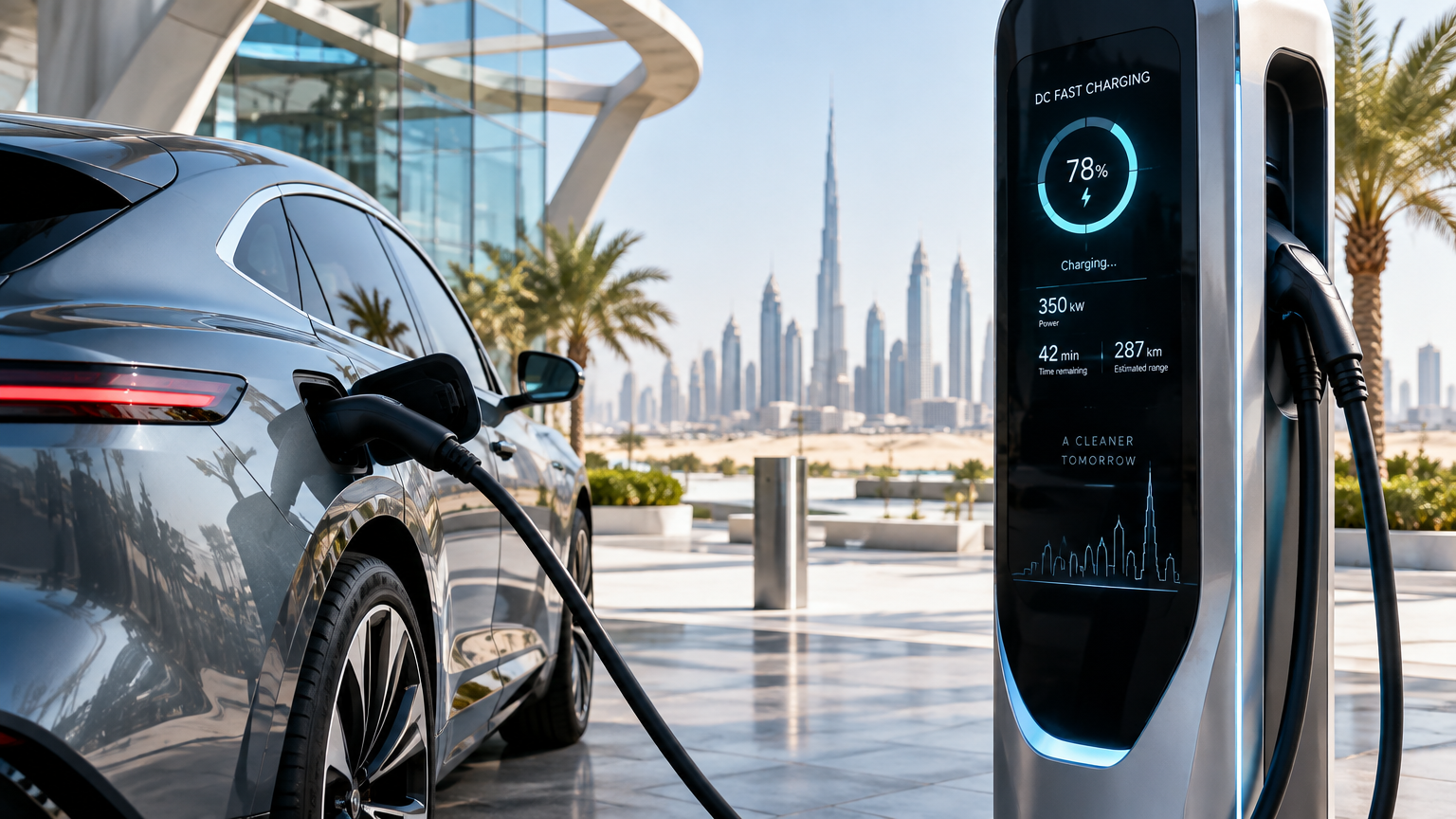
Choosing the right charging method in Dubai depends on your daily driving, budget, and access to home charging. This guide explains when DC fast charging Dubai delivers real value—and when slower AC charging works just fine for your needs.
Quick Summary
- Explains AC Level 2 vs DC fast charging: how they work and what charging speeds you’ll get in real life for Tesla Model 3, Hyundai Ioniq 5, and BMW iX.
- Compares prices per kWh and per 100 km between slow AC, standard DC fast (public), and premium DC like Tesla Superchargers & ADNOC.
- Maps which operators in Dubai offer which charger types (DEWA Green Charger, ADNOC e-Tap, Tesla Superchargers, ENEC etc.).
- Includes a decision matrix: based on daily mileage, whether you can charge at home, and what kinds of trips you do.
- Helps you answer: Should I pay extra for fast charging or is slow charging enough for my driving?
AC Level 2 vs DC Fast Charging: What’s the Difference?
- AC Level 2 (slow to medium) uses alternating current at up to about 22 kW. These are your regular DEWA Green Chargers with Type-2 sockets, commonly found at malls and street locations.
- DC fast charging (50 kW–250 kW+) converts AC at the charger, sending direct current straight to the EV battery. It lets you go from 10–80% in 15–30 minutes on good DC chargers. Essential for quick recharges on longer journeys. (dewa.gov.ae)
Charging speeds for popular EVs in Dubai under ideal conditions:
| EV Model | Battery Size | Max AC Charge Rate (real-world) | Max DC Fast Charge Rate | Typical 10–80% DC Time |
|---|---|---|---|---|
| Tesla Model 3 | ~75-80 kWh (Long Range) | ~7-11 kW (public AC, home) | Up to ~250 kW with V3 Supercharger | ~20-25 minutes (chargeae.com) |
| Hyundai Ioniq 5 | ~72.6-77 kWh (Long Range) | ~11 kW (public AC) | Up to 350 kW on ultra-fast DC | ~18 minutes (hyundai-uae.com) |
| BMW iX | ~76-111 kWh | ~11-22 kW AC | Up to ~150-200 kW DC | ~25-30 minutes (en.wikipedia.org) |
These are ideal numbers. Temperature, battery state, charger load, and other factors will affect actual speeds.
How Much It Costs: AC vs DC in Dubai
DEWA & UAE Regulated Rates (Cabinet Resolution 81/2024)
- Public AC charging via DEWA Green Chargers: AED 0.70/kWh + VAT (≈ AED 0.735/kWh) (dewa.gov.ae)
- Public DC fast charging (50 kW+): AED 1.20/kWh + VAT (≈ AED 1.26/kWh) (dewa.gov.ae)
Tesla Superchargers
- Tesla’s DC Supercharger rate in Dubai typically runs around AED 1.50/kWh at 250 kW stations in Dubai urban areas. (chargeae.com)
- Prices vary by location—sometimes as low as AED 0.73–AED 1.30 based on public reports. (plaidcars.com)
Home Charging (using DEWA residential electricity)
- Typically AED 0.23–0.38 per kWh for overnight charging. Your actual rate depends on your electricity consumption slab. (plaidcars.com)
Cost-Per-100 km Comparison
Here’s what 100 km of driving costs for a mid-size EV in Dubai (typical consumption: 16–18 kWh/100 km). We assume using the most efficient part of the battery.
| Charging Type | Rate (AED/kWh) | Cost per 100 km |
|---|---|---|
| Home Overnight (DEWA residential) | AED 0.23–0.38 | AED 4–7 |
| DEWA Public AC (Green Charger) | AED 0.70 | AED 11–13 |
| DEWA / UAEV Standard DC Fast | AED 1.20 | AED 19–22 |
| Tesla Supercharger Premium DC | AED 1.50 (or site rate) | AED 24–27 |
- At 1,500 km/month, home charging might cost AED 60–100, while frequent DC fast charging runs AED 190–230+ depending on your network choice. (plaidcars.com)
Who Offers Which Charger Types in Dubai
| Network / Operator | Connector Types and Power | Where Found (Areas) |
|---|---|---|
| DEWA Green Charger | AC 7–22 kW public chargers, fast chargers (43 kW AC + 50 kW DC), ultrafast 150 kW DC options. (dewa.gov.ae) | Petrol stations (ENOC/ADNOC), malls, public streets |
| ADNOC / ADNOC e-Tap | DC fast chargers (CCS2 / CHAdeMO), typically 60–150 kW | Fuel-forecourt hubs across Dubai–Abu Dhabi highway, Al Quoz, and beyond |
| Tesla Supercharger Network (UAE) | Tesla V3 / V4 Superchargers, up to 250 kW at many locations. (chargeae.com) | Dubai Urban, Dubai Marina, Dubai Hills Mall, plus along E11 highway |
| Other Licensed CPOs (UAEV, ChargePoint, etc.) | DC fast chargers (various power levels), AC chargers across network | Expanding across Dubai suburbs, highway service areas. (dewa.gov.ae) |
When Fast Charging Beats Slow: Decision Matrix
Use this matrix to assess your own driving and charging needs:
| Your Profile | Home / Workplace Charging? | Daily Driving Distance | Long Trips (inter-emirate, highway)? | What Makes Sense |
|---|---|---|---|---|
| Mostly <60 km/day, live in villa or have garage | ✅ Yes | Low to Moderate | Rarely | AC Level 2 at home + occasional slow public AC; DC fast only when needed (cost is high) |
| 60–150 km/day, commute + errands | Partial or shared charging | High | Occasional (trip to Abu Dhabi etc.) | Mix: Home AC daily; DC fast for highway or unplanned quick fill-ups |
| Live in apartment, limited home options | ❌ No | Variable | Frequently travel long distances | DC fast becomes valuable; explore faster AC charger installation at home if feasible |
| Often driving highways or last-minute schedules | Mixed | High | Frequent long trips | Prioritize DC fast in your route; consider premium options like Tesla Supercharger or ADNOC for speed |
Case Studies: How it Plays Out
Scenario A: Local commuter with home charging
You drive 50 km/day with access to home charging, mainly around Dubai (Downtown, Marina). Long trips past Abu Dhabi are rare. AC charging meets nearly all your needs. Fast DC is expensive per kWh and only useful in emergencies.
Scenario B: Commercial driver or frequent traveler
You drive a taxi or delivery service across the Dubai–Abu Dhabi corridor often. Time is money. Home charging helps, but DC fast stations on route (ADNOC, Tesla Supercharger) are essential. You absorb the higher cost because of the time saved.
Scenario C: Tesla Model 3 owner with mixed usage
Tesla Model 3 Long Range, 18 kWh/100 km. Home charging: AED 4–7/100 km. DEWA DC at AED 1.20/kWh: AED 22/100 km. Tesla Supercharger: ~AED 25/100 km. Using DC rarely keeps your overall monthly cost low.
Should You Pay Extra for Fast Charging?
You should pay extra for DC fast charging if:
- You’re frequently on the go and need quick fill-ups (long trips, travel, no home charging).
- The time you save outweighs the extra cost per km.
You don’t need to pay extra if:
- You can charge overnight at home or at your workplace.
- Your daily drive is modest (<80–100 km) and you can plan ahead.
The key is balancing cost versus convenience. Extra cost makes sense only when time, stress, or travel patterns require it.
Frequently Asked Questions
Q1: Does DC fast charging harm battery health more than AC or home charging?
Not significantly for modern EVs when used properly. Heat and charge rate matter most. Most EVs taper down charge speed past 80%. Use DC fast charging as needed, not habitually to full 100%.
Q2: Can non-Tesla cars use Tesla Superchargers in Dubai?
Tesla UAE Superchargers use CCS2/DC for many locations, which non-Tesla EVs support. Check each stall’s connector type. The Tesla app will show compatibility. Watch for Tesla-proprietary plugs in some older stations. (evplus.ae)
Q3: What are hidden costs with DC fast charging?
Idle fees apply if you’re plugged in after charging completes. Premium pricing and congestion charges at busy chargers also add up. Tesla Superchargers, for example, set idle fees when stalls are occupied. (plaidcars.com)
Q4: Should I plan for a faster home charger (e.g., 22 kW vs 7 kW)?
If your home electrical setup supports it and your vehicle accepts higher AC rates, yes. It reduces