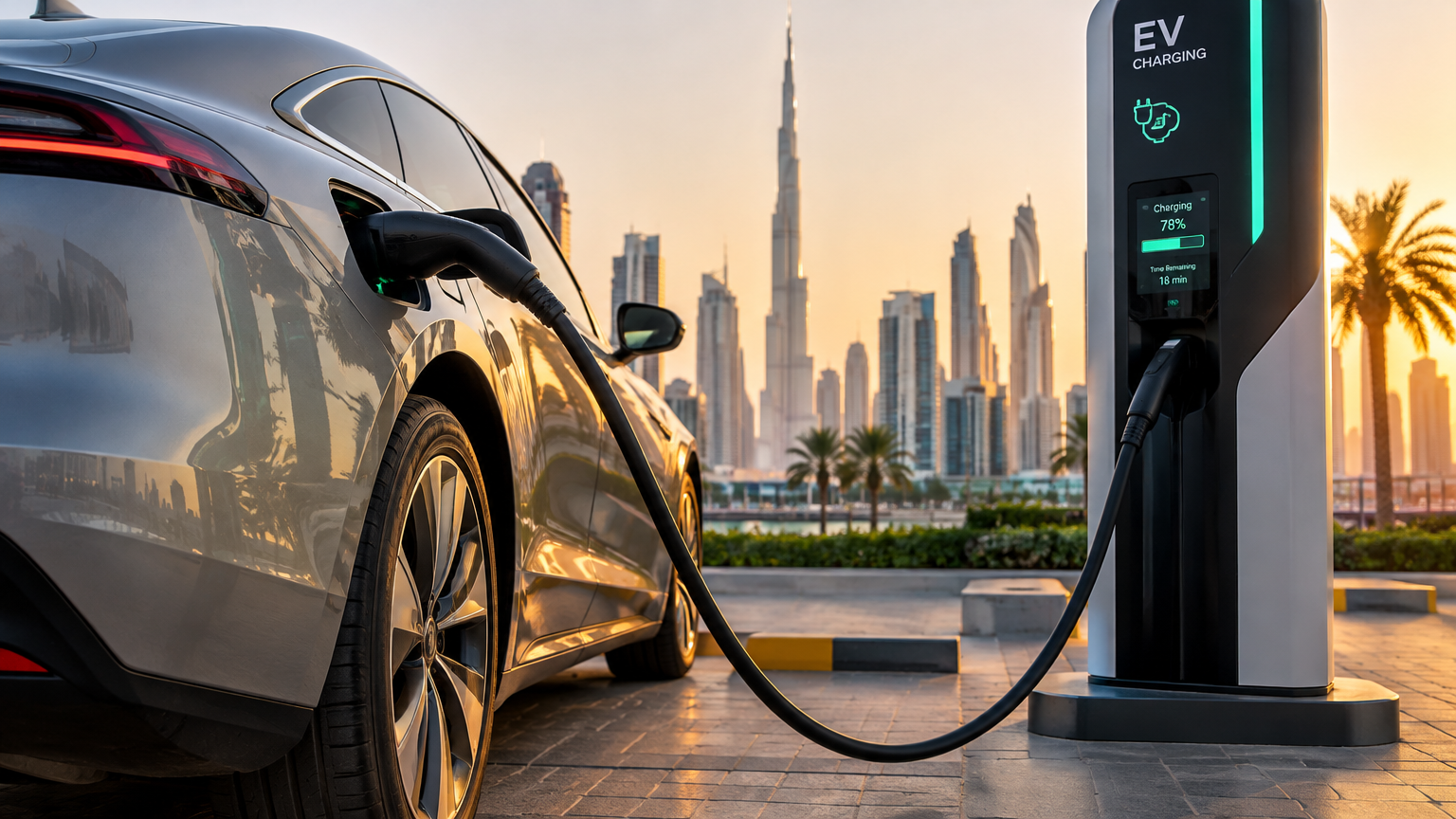
Driving an EV for rideshare in Dubai requires a smart charging strategy. This guide covers EV charging Dubai rideshare costs, infrastructure, and profitability for Uber, Careem, and taxi operators. You’ll learn how to calculate cost per kilometre in AED, compare public versus home charging, navigate congestion at busy hubs, and determine whether a home or depot charger makes financial sense for your operation.
Quick Summary
-
Public AC charging costs AED 0.70/kWh (+ VAT); DC fast charging runs AED 1.20/kWh (+ VAT) under the unified tariff introduced September 30, 2024. (dewa.gov.ae)
-
Home charging with residential DEWA rates is significantly cheaper—roughly AED 0.29 to AED 0.38/kWh. This translates to AED 0.05–0.06/km versus AED 0.10–0.13/km on public chargers. (chargeae.com)
-
Home charger installation (villa) ranges from AED 2,400–5,000 including equipment and labour. Commercial fleet depot installations cost more—AED 4,500–22,000+ per bay depending on speed and connector type. (dubaismarthome.ae)
-
Congestion plagues popular fast-charging stations near airports, major malls, and hotel areas, especially weekends and peak hours. Waiting times often reach 30–90+ minutes. (reddit.com)
-
Rideshare EV driving can be profitable—particularly with high daily mileage, careful charging strategy (mostly home or depot with fast top-ups as needed), and selective use of public DC chargers.
Find the best EV charging solution in Dubai — get a free quote today.
What Drives Your Costs and Profits
Profitability for rideshare drivers hinges on controlling both fixed and variable expenses. For EV operators, several factors directly impact your bottom line:
- Energy cost per km — kWh consumption multiplied by your charging rate
- Charging downtime — waiting at public stations reduces active earning hours
- Fixed costs — vehicle lease or depreciation, licensing, permits, insurance
- Variable costs — maintenance, tyres, tolls, cleaning
Understanding your cost per kilometre is essential for pricing competitively and maintaining margins.
Cost-Per-Kilometre Calculations: EV Charging Dubai Rideshare Economics
| Charging Scenario | Price per kWh | Typical EV Efficiency | Cost per km |
|---|---|---|---|
| Public AC charging | AED 0.70 + VAT ≈ AED 0.735/kWh | 6–7 km per kWh | ≈ AED 0.10–0.13/km |
| Public DC fast charging | AED 1.20 + VAT ≈ AED 1.26/kWh | 6–7 km per kWh | ≈ AED 0.17–0.21/km |
| Home/residential rates | AED 0.29–0.38/kWh | 6 km/kWh | ≈ AED 0.05–0.06/km |
Petrol vehicles typically cost AED 0.28–0.35/km for fuel alone. High-mileage rideshare drivers rack up 200–300 km daily. At this volume, home charging’s cost advantage becomes decisive. Charging exclusively at home saves AED 3,000–4,500 monthly compared to public DC chargers.
Public Charging Networks and Fastest Turnaround Times
Location and charging speed matter as much as price. Balance speed, convenience, and downtime to optimise your schedule.
Major Networks in Dubai
- DEWA EV Green Charger: AC chargers (22 kW), fast DC units (50–150 kW), and ultra-fast hubs. Most extensive network. (dewa.gov.ae)
- Tesla Superchargers: High-speed DC (150–250 kW) at select locations. Best for Tesla owners. (plaidcars.com)
- ENOC, ADNOC, UAEV: Fast chargers at petrol stations and highways. Network continues to expand. (dewa.gov.ae)
Realistic Charging Times and Congestion
A DC fast charger (50–150 kW) delivers 20–80% charge in approximately 30–60 minutes. Larger battery packs may require longer durations. However, peak congestion at popular hubs significantly extends this window.
High-traffic zones include Dubai International Airport, Downtown Dubai, JBR, and major shopping malls. Weekend afternoons and evening rush hours see the worst queues. Drivers report waiting 30–90+ minutes just for a charging spot, turning a quick top-up into a major disruption.
For schedule-driven work, these delays directly reduce billable hours. Plan public DC use strategically—use it for big charges, not frequent short stops.
Home and Depot Charger Installation: Costs and ROI
If you access home or depot parking—villa garage, fleet storage, or company lot—installing dedicated chargers transforms your economics.
Requirements and Setup
Work with a DEWA-approved electrical contractor. Installation includes proper wiring, circuit protection, earthing, and safety compliance behind your metre. Charger options depend on your needs:
- Level 2 AC (7–22 kW): Single-phase 7 kW suits daily top-ups; three-phase 11–22 kW handles fleet use or large battery packs faster. (jadgarage.com)
- Commercial DC fast chargers (50–150 kW): For fleet depots. High upfront cost; substantial power supply upgrades required. (fixerguy.ae)
Installation Costs
| Setup Type | Installed Cost (AED) |
|---|---|
| Villa 7–11 kW charger (short cable run) | AED 2,400–5,000 |
| Commercial depot, multi-bay AC/DC | AED 4,500–22,000+ per bay |
Payback Period and Financial Impact
Drive 200–300 km daily, and home charging saves approximately AED 70–120 per day versus public AC or DC. Multiply by 25 working days: that’s AED 1,750–3,000 monthly in energy savings alone.
A AED 5,000 villa charger investment recovers within 2–3 months for active daily drivers. Fleet operations break even even faster.
Apartment dwellers face obstacles. Building management approval, shared electrical infrastructure, and long cable runs can balloon costs. Older buildings may require expensive power supply upgrades. Factor these complications into your decision.
Dubai-Specific Factors That Change the Economics
Climate and Seasonal Impacts
Summer heat intensifies air conditioning use and battery cooling needs. Efficiency drops 10–20%, requiring more frequent charging. Winter offers modest gains, but the summer effect dominates most of the year in Dubai.
Peak Hours and Revenue Timing
Morning rush, evening peak, and airport transfer windows generate premium fares. However, charging during these high-demand periods costs you active earning time. Align charging with low-revenue windows—late night, early morning, or shift breaks at quiet depots.
Licensing and Fixed Costs
Rideshare operations require limousine permits, specific licensing, and fleet compliance. EVs lower fuel and maintenance expenses, but higher vehicle purchase costs mean depreciation is more significant. Utilisation rate becomes critical—higher daily mileage improves the business case.
Infrastructure Expansion
DEWA operates approximately 1,860 public charging points across Dubai, including ultra-fast, fast, public, and wall-box chargers as of mid-2025. An additional 208 ultra-fast chargers are contracted for Dubai Taxi Company sites. Growth continues, but peak-hour congestion remains a real constraint. (dewa.gov.ae)
Profitability Analysis: Making Money with EV Rideshare
Let’s model realistic scenarios to see whether EV rideshare profits hold up.
Daily Energy Cost Comparison
Assumptions:
- Daily distance: 300 km
- EV efficiency: 6 km/kWh
- Home charging: AED 0.30/kWh
- Public DC: AED 1.26/kWh
Daily consumption: 300 km ÷ 6 km/kWh = 50 kWh
- Home charging only: 50 × AED 0.30 = AED 15/day
- Public DC only: 50 × AED 1.26 = AED 63/day
- Daily difference: AED 48
- Monthly difference (25 working days): AED 1,200
This doesn’t account for lost trips due to charging delays at public stations. Factor in 1–2 forgone trips daily when using public chargers during peak hours—another AED 150–300 in lost revenue.
Revenue and Margin Potential
Published data shows Uber X drivers in Dubai earning AED 200–450/day gross, or AED 5,000–11,000/month before expenses. After platform commission (25–30%), vehicle lease, insurance, fuel/energy, maintenance, and tolls, net margins vary widely.
The EV advantage emerges clearly: lower fuel/energy cost (AED 15 vs. AED 40–50 for petrol), minimal maintenance, no oil changes. These savings compound daily, pushing EV rideshare profitability above petrol equivalents when utilisation is high.
Optimal Charging Strategy for Maximum Uptime
- Primary source—home or depot: Overnight or between shifts. Lowest cost, zero interruptions, most convenient.
- Secondary source—public DC when essential: Shift changes, airport runs, battery near critical. Time top-ups strategically.
- Avoid congested public hubs: Skip peak-hour charging at Dubai Int’l Airport, downtown malls, and hotel zones. Seek quieter stations on highways (E11, E311) or new UAEV/ENOC locations away from tourist areas.
This approach keeps energy costs low while maximising earning hours and minimising frustration.
Public vs. Home Charging: Side-by-Side Comparison
| Factor | Public DC | Public AC | Home or Depot |
|---|---|---|---|
| Price per kWh | AED 1.26 | AED 0.735 | AED 0.29–0.38 |
| Cost per km | AED 0.17–0.21 | AED 0.10–0.13 | AED 0.05–0.06 |
| Time per session | 30–60 minutes + waiting | 1–2 hours | Overnight (idle time) |
| Waiting and delays | Severe, especially peak hours | Moderate | None |
| Installation cost | None (existing network) | None (existing network) | AED 2,500–5,000
|