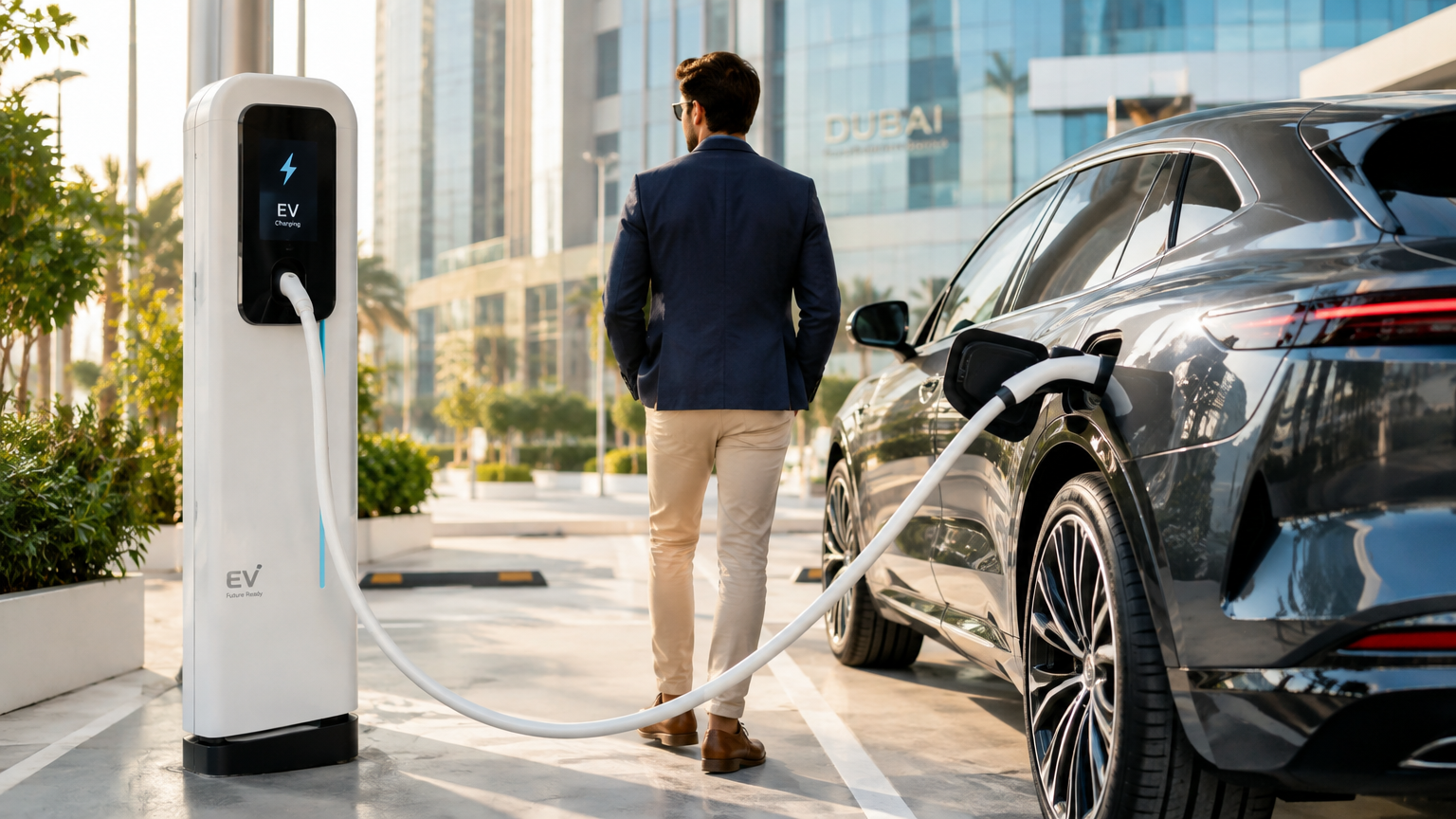
EV Charging Dubai Office: Best Solutions 2026
Quick Summary
- Current regulatory position: DEWA’s EV Charging Regulation requires approval for private and public EV chargers, but no law forces landlords to install them.
- How tenants can request installation: formal request to landlord, load assessment, and DEWA technical approval if proceeding.
- Landlord obligations under Dubai tenancy law: what they must provide versus what remains negotiable, plus cost-recovery rules.
- Smart load-management systems enable multiple chargers without expensive infrastructure upgrades.
- Practical checklist for commercial tenants and fleet managers before signing a lease in Dubai.
Can Your Employer Legally Be Required to Install Workplace Chargers?
If you’re an employee or fleet manager in Dubai asking whether your employer must install workplace chargers, the short answer is: not automatically. Neither DEWA’s EV Charging Regulation nor Dubai Tenancy Law currently requires landlords or employers to provide EV chargers for tenants or employees.
However, legal frameworks exist that allow you to request them, negotiate their inclusion, and set up private charging infrastructure. The EV Charging Infrastructure Regulation and DEWA Technical Regulations provide the pathway. Understanding these rules helps you build a stronger case for EV charging Dubai office installations at your workplace.
Regulatory Position Under DEWA’s Commercial Connection Guidelines
DEWA’s EV Charging Regulation Explained
Both public and private EV charging equipment in Dubai must obtain DEWA approval and comply with their technical standards. Here’s what you need to know:
- Private charging equipment (restricted access for a single organisation) has fewer connector restrictions than public chargers.
- Public chargers must use Type-2 connectors for AC and CCS2 for DC charging.
- Any operation of public charging infrastructure requires a CPO (Charge Point Operator) licence from DEWA—whether charging is free or fee-based.
Commercial Connection Guidelines for Office Fit-outs
When tenants request new electricity connections or modifications like adding load for chargers, DEWA requires specific documentation:
- Technical drawings and load specifications
- Wiring plans and safety compliance documents
- A No Objection Letter (NOL) from the landlord
- Compliance with EV Charging Technical Regulations covering design, safety, correct contractor selection, and metering
What Landlords Are and Aren’t Obligated to Provide
Landlord Obligations Under Dubai Tenancy Law
Under Law No. 26 of 2007 (as amended), landlords have specific responsibilities:
- Hand over leased premises in condition allowing full use for the stated purpose, including necessary repairs and works to enable intended use.
- Provide required approvals when tenants conduct fit-outs or works needing regulatory sign-off—EV charger installations typically fall into this category.
- Cannot interfere with a tenant’s quiet enjoyment of premises or services. Direct refusal to allow electricity or block safe installation may breach tenant rights.
What Landlords Are Not Required to Do
There is currently no law requiring employers or landlords to install EV charging stations as a standard amenity. Installation remains negotiable, not mandatory. Similarly, landlords aren’t automatically responsible for paying all infrastructure upgrades needed to support multiple high-load chargers unless explicitly agreed in the lease.
Costs, Cost-Recovery, and DEWA Account Responsibility
Who Holds the DEWA Account?
The landlord typically holds the DEWA account for a commercial building’s common services. Tenants may be responsible for sub-metered consumption if the lease specifies this arrangement. Whether EV charging gets billed via landlord meter, tenant sub-meter, or separate metering depends on your lease terms and DEWA’s approval of the connection point.
Cost Components to Budget For
Installation costs include equipment (charging stations and wiring), installation labour, possible civil works or trenching, power supply upgrades if needed, metering equipment, and DEWA approval fees. Operating costs cover electricity at commercial tariffs, regular maintenance, insurance, and licensing fees if operating public charging infrastructure.
Cost Recovery Models
If chargers serve only your employees or company fleet, your organisation bears costs directly. When landlords provide chargers, they typically recover costs through higher rent, service charges, or separate charging fees—but only if the lease permits. Public charging fees must follow DEWA regulation: billing is based on electricity consumption (kWh plus VAT), not time plugged in, though overstay fees are allowed under transparency rules.
Smart Load-Management Systems: Multiple Chargers Without Expensive Upgrades
Need several EV chargers at your office for fleet or employee use? Smart load management systems solve capacity constraints without doubling your electrical supply.
How These Systems Work
Staggered charging schedules prevent all vehicles from drawing peak power simultaneously. Dynamic load balancing automatically limits individual charger output to stay within your building’s total supply. You can also integrate energy storage or solar PV to offset peak demands, or install per-charger metering for fair cost allocation and user visibility.
While these systems cost more upfront, they’re typically far cheaper than upgrading transformer capacity or securing entirely new power infrastructure from DEWA.
How to Formally Request Charger Installation
Step 1: Internal Proposal
Write to facility management or your landlord proposing EV charging installation. Include your reasons—employee benefits, talent attraction, ESG goals—plus a preliminary estimate of charger numbers, estimated load, and possible locations like parking areas or basements.
Step 2: Load Assessment and Technical Study
Hire a DEWA-approved electrical consultant to assess current capacity, wiring, safety standards, and metering. They’ll determine whether your existing supply is sufficient or needs upgrading.
Step 3: Obtain Landlord No Objection Letter (NOL)
Your landlord must sign an NOL confirming consent to the works and load changes. DEWA requires this document before approving any connection or alteration application.
Step 4: Submit DEWA Approval and Licensing Application
Submit layout drawings, load calculations, wiring plans, the NOL, and contractor credentials to DEWA. If your chargers serve public or shared use beyond your company, apply for a CPO licence. Private-use chargers follow different rules and don’t require a CPO licence.
Step 5: Installation and Commissioning
Use only DEWA-approved contractors. Ensure smart load management systems and correct metering are installed correctly.
Step 6: Operation and Billing Setup
Establish your billing mechanism using a sub-meter or internal charge allocation. Ensure rates comply with DEWA regulation: billed by kWh, VAT applied, no hidden subscriptions for public usage without proper licensing.
Checklist: Questions to Ask Before Signing a Commercial Lease
| Question | Why It Matters |
|---|---|
| Does the lease include EV charging rights or allow alterations? | Without permission, getting chargers installed later may be impossible. |
| Who holds the DEWA account for the premises and parking area? | This determines who pays DEWA bills, installation costs, and infrastructure upgrades. |
| What is the current electrical load capacity and available spare capacity? | Essential for assessing feasibility without expensive upgrades. |
| What approvals are required (landlord, DEWA, Municipality)? Any past precedents? | More unknowns mean longer timelines and higher costs. |
| Who is responsible for equipment purchase, installation, maintenance, and insurance? | Clarifying this upfront prevents costly disputes. |
| How will operational costs (electricity, maintenance) be allocated or billed? | Prevents surprise charges in running costs. |
| Will the building support smart load-management or shared infrastructure? | Avoids costly infrastructure upgrades later. |
| Is public or shared access planned? Will you need a CPO licence? | Public charging involves stricter regulatory requirements. |
| What are landlord obligations under building bylaws and DEWA regulation? | Know what you can legally enforce. |
| Can EV charging be included as a lease amenity or condition? | Strengthens your contractual position to request chargers. |
Frequently Asked Questions
Can I Force My Employer or Landlord to Install Workplace Chargers?
No current regulation mandates that landlords or employers provide EV charging. Installation is negotiable and depends on lease terms. However, Article 18 of Dubai Tenancy Law and the EV Charging Regulation require landlord cooperation when approvals are needed for your installation.
Will I Be Billed for Charging Electricity?
Yes, but billing must comply with DEWA rules. Public chargers are billed per kWh with VAT, showing electricity and fuel surcharge components separately. Time-based fees or subscriptions follow transparency rules. Private charging arrangements are more flexible and depend on your lease agreement.
Will Multiple Chargers Overload Our Power Supply?
Possibly—but smart load-management systems prevent overloading without major upgrades. These systems balance load, schedule staggered charging, and can integrate battery storage to maintain capacity within limits.
Do Private Chargers Require a CPO Licence?
No. CPO licences are required only for public charging equipment. Private chargers for staff or fleet use need DEWA approval and must follow technical regulations, but you don’t need a public CPO licence.
What If My Landlord Refuses Permission?
You may have legal recourse under Tenancy Law. Article 34 prohibits interference with quiet enjoyment and service disconnection. If reasonable installation requests are denied and prevent your business operations, you could potentially file a claim. Success depends on lease wording, evidence, and tribunal decisions.
Start Your EV Charging Journey Today
If you’re exploring EV charging Dubai office solutions for your fleet, staff benefits, or sustainability goals, now’s the time to gather information and negotiate clearly with your landlord or property manager.
Get expert guidance on EV charging installations from professionals who understand DEWA regulations, tenant-landlord law, and smart load management. Contact a certified installer to discuss your specific needs and receive a free assessment.