Quick Summary
- This guide shows where freezone employees—such as those in JAFZA, DMCC, Dubai Internet City (DIC)—can access public EV charging, including DEWA and third-party stations inside and outside freezones.
- It explains workplace charger installation rules, costs, and whether employers can subsidise or provide chargers under current UAE and freezone regulations.
- You’ll see how shift workers and commuters from Abu Dhabi or Sharjah can plan daily EV charging Dubai freezone solutions if home charging isn’t enough.
- It includes comparison tables: charging cost (AC vs. DC), charger types, and a “daily plan” checklist to help decide what works for your commute.
- By the end, you’ll know how to avoid range anxiety at work without relying solely on rare dedicated office chargers.
Understanding EV Charging in Dubai Freezones
What counts as “EV charging Dubai freezone”?
“Freezone” refers to areas like JAFZA, DMCC, DIC, and DAFZ—zones with their own jurisdiction for business setup and sometimes infrastructure. When you search for EV charging Dubai freezone options, you’re looking for charging access both inside your freezone and nearby on routes to and from work or home.
Public EV Charging Infrastructure
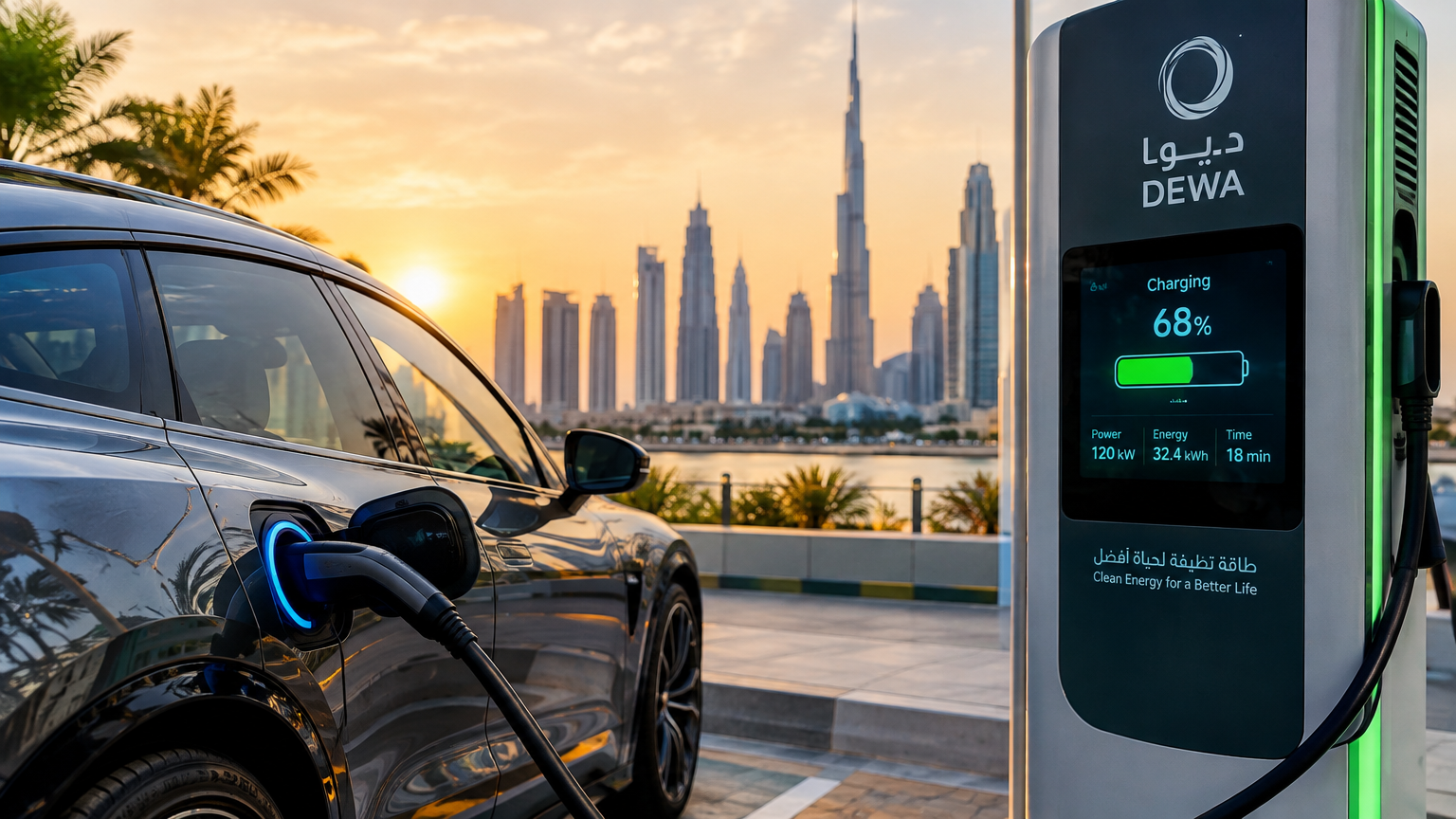
- The DEWA EV Green Charger network now has over 1,864 public charging points across Dubai by end of Q4 2025. These include ultra-fast DC, fast, public (two 22 kW AC sockets), and wall-box chargers. (dewa.gov.ae)
- Locations include chargers within freezones—for instance:
- A 22 kW DEWA wall-box in JAFZA, at the JAFZA Food Court parking (plugshare.com)
- DEWA charging stations at Jebel Ali Free Zone petrol or utility sites (propertyfinder.ae)
- Third-party networks like SHABIK/CATEC also cover Dubai and Abu Dhabi with both AC Type 2 and DC CCS2 chargers. (desk.catec.ae)
Regulations & Cost
| Topic | Key Details |
|---|---|
| Regulatory Scope | DEWA’s EV Charging Regulation applies in all Dubai, including freezones and special development zones like DIFC. Freezone employers follow the same DEWA rules for public or public-access workplace chargers. (dewa.gov.ae) |
| Licensing | To install a public or workplace charger accessible beyond private use, your employer or a third party needs a CPO Licence (Charge Point Operator), whether chargers are free or paid. (dewa.gov.ae) |
| Technical Standards | Equipment must be DEWA-approved, include safety conformity certificates, and comply with DEWA’s technical regulations. Chargers connect via DEWA’s distribution system. (dewa.gov.ae) |
| Charging Fees | As of 30 September 2024, standard rates for registered users are AED 0.70/kWh + VAT for AC charging and AED 1.20/kWh + VAT for DC charging. (dewa.gov.ae) |
How Freezone Employers Can Support EV Charging
Can my company install workplace chargers?
Yes. Under DEWA’s regulations, any private organisation—including freezone companies—wanting to install public access or shared EV charging equipment must apply for a CPO Licence. (dewa.gov.ae)
For restricted-access chargers in employee parking or gated staff lots, there are simplified rules for AC chargers and DC up to 50 kW. If chargers are purely private—for example, only for company-owned cars or employee reimbursement—the regulatory burden is lighter, but still requires compliance with DEWA safety and technical regulations.
Can employers subsidise charging?
Yes. Employers may offer subsidies, reimbursements, or provide dedicated workplace charging. There is no law preventing this. Costs for electricity, installation, and maintenance can be budgeted under facilities management in many freezones.
Regulations freezones should check
- Make sure parking bays with EV chargers are designated and reserved for EVs during charging, not used by other vehicles. DEWA regulation prohibits misuse. (dewa.gov.ae)
- Ensure chargers meet DEWA’s technical and safety standards, including EVSE certifications and connection approvals. (dewa.gov.ae)
- If charging is offered to visitors or the public outside staff, ensure proper contracts, pricing transparency, and licensed CPO operation.
Planning Daily Charging: For Commuters & Shift Workers
If you commute long distances from Sharjah or Abu Dhabi, or work shifts that cover nights, relying on home chargers alone won’t work. Here’s how to plan your charging strategy.
Comparison across charging options
| Charger Type | Typical Location | Power | Time to Add ~50 kWh (≈200–300 km) | Cost |
|---|---|---|---|---|
| Home charger | Residential villa or apartment | Wall box AC 7–22 kW | 2–8 hours overnight | Charged at home electrical rate; free if employer reimburses |
| Workplace shared charger | Office parking | AC 22–43 kW, or DC up to 50 kW | 1–2 hours with fast AC; <1 hr with DC | DEWA public tariff if public access; free if employer covers cost |
| Public DEWA Green Charger | Freezones, petrol stations, malls | AC, DC, ultra-fast options | Varies by charger and state of charge | AED 0.70/kWh AC, AED 1.20/kWh DC + VAT for registered users (dewa.gov.ae) |
| Third-party network (SHABIK, etc.) | Along highways, malls, service stations | DC CCS2, AC Type 2 | Fast DC: ~30 mins for 80%; AC slower | Slightly higher fees for premium locations (desk.catec.ae) |
Sample daily charging routines
Shift worker (night shift starting at 10pm in DMCC, commuting from Sharjah):
- Leave home with full charge or approximately 80%
- Plug in briefly during lunch break at freezone workplace shared charger, if available
- Use DEWA Green Charger near Garhoud or Al Nahda for final charging after shift
Commuter from Abu Dhabi working 9am–6pm in JAFZA:
- Charge overnight at home in Abu Dhabi
- Identify DEWA or SHABIK charger near freezone entrance (for example, Jebel Ali petrol station)
- Use workplace charger or mall charger during lunch if needed for longer shifts
Freezones with On-Site or Nearby Charging
| Freezone | Known Charger Locations | Employer Charging Options |
|---|---|---|
| JAFZA | DEWA Green Charger 22 kW wall box at JAFZA Food Court, Expo Rd (24/7) (plugshare.com); JAFZA power and fuel stations also have DEWA units. (hidubai.com) | Employers in JAFZA can install AC or small DC chargers in loading or parking areas; CPO license required if offering public access |
| DMCC | Multiple DEWA Green Chargers in and around DMCC at mall car parks and near metro stations (dewa.gov.ae) | Companies often include 22–43 kW AC chargers in staff parking; some tech firms use lease agreements with CPOs |
| Dubai Internet City & Similar Freezones (DIC, TECOM) | Limited options within gated business campuses; nearest options at malls (for example, Mall of the Emirates, Dubai Media City) or along Petra or Al Quoz routes | Shift workers rely on mobile charging, DEWA guest mode, and employer allowances |
How Employees Can Plan Daily Charging Without Office Chargers
If your employer doesn’t provide a charger at your workplace, follow these steps to avoid range anxiety:
- Map your commute. Plug public DEWA and SHABIK chargers near freezone entrances and along routes between home and work shifts into your route planner.
- Identify backup charging options. Use shopping malls, petrol stations, or public parking with Green Chargers. DEWA’s app and map services show live availability. (dewa.gov.ae)
- Time your charging strategically. Use low-traffic times (late evening or lunch break) to reduce wait time and AC station congestion.
- Carry your own cables and adapters. Most DEWA chargers are AC Type-2 and DC CCS or CHAdeMO, but verify your EV’s requirements.
- Negotiate with your employer. Ask HR or facility management to consider installing workplace chargers. Present the cost-benefit: improved employee satisfaction, green credentials, and possible subsidy structures.
Summary Checklist for Your Decision
- Check if your freezone (JAFZA, DMCC, etc.) has on-site DEWA chargers or licensed CPOs.
- Understand your commute type: distance and shift timing.
- Decide if home charging covers enough overnight or you need workplace, shared, or public charging.
- Estimate costs: AC versus DC, and DEWA tariff calculations for your weekly mileage.
- If charger provision is needed at work, check licensing requirements, safety standards, and budget allocation.
Frequently Asked Questions
Q1: Can I rely on free chargers inside freezones for daily shifts?
Generally no. DEWA pricing rules forbid “free-for-all” public chargers operating below prescribed tariffs unless properly licensed as a free-provision CPO. Chargers designated for employees only (not public or visiting vehicles) can be subsidised internally but must still comply with DEWA safety and technical regulations. (