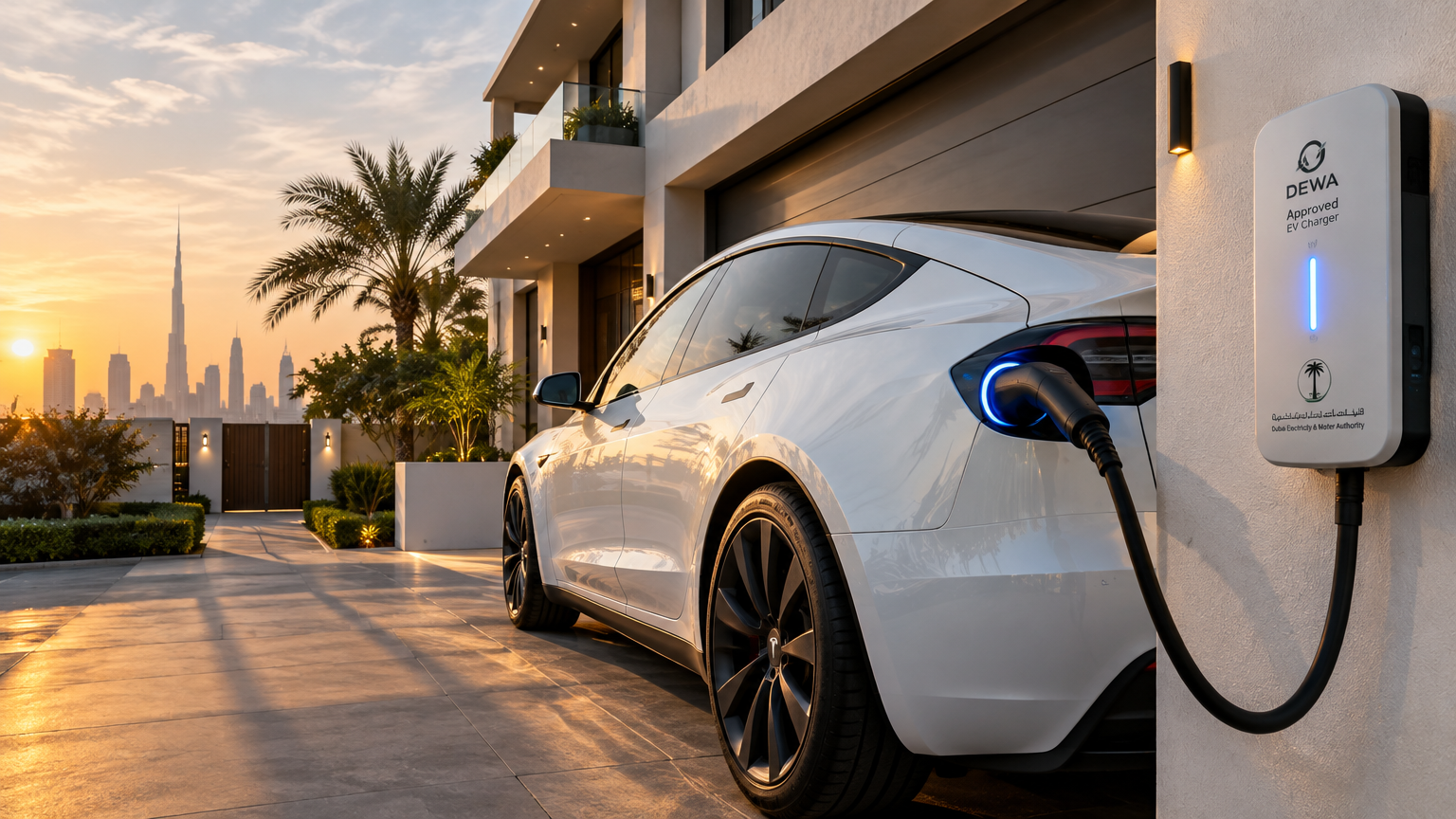
Installing a home EV charger in Dubai requires home EV charger DEWA approval to ensure compliance with safety and electrical standards. This comprehensive guide walks you through every step—from securing landlord approval to passing final inspection—so you understand exactly what to budget, who to hire, and how long the process takes.
Quick Summary
- This article covers every step to get your home EV charger DEWA approval in Dubai, including landlord/developer NOC, load study, contractor selection, inspection, and realistic timelines.
- You’ll see a detailed cost breakdown in AED (permits, materials, labour) so you can budget accurately for villas and apartments.
- You’ll learn what to look for in equipment and contractors—safety standards, certifications, location requirements, and electrical capacity considerations.
- You’ll understand Dubai’s regulatory requirements: DEWA technical regulations, Building Code rules, when approvals are needed, and differences between villas and apartments.
- A downloadable checklist ensures you don’t miss any documents or approval steps.
Why DEWA Approval Matters for Your Home EV Charger
“Home EV charger DEWA approval” means ensuring your installation meets Dubai Electricity & Water Authority safety and technical standards. DEWA doesn’t typically issue a separate “EV charger permit” for residential installations. However, your installation must:
- Be completed by a DEWA-approved electrical contractor (dewa.gov.ae)
- Comply with DEWA’s EV Charging Technical Regulations, Dubai Building Code G.5.2, BS 7671 wiring standards, and IEC safety codes
- Include a dedicated circuit with proper protection devices (residual current device, Type A protection)
Villa installations are typically straightforward. Apartment installations require additional approvals: landlord or community NOC, management permission, and suitable supply routing.
Step-by-Step Installation Process
| Step | Action Required | Responsible Party | Timeframe |
|---|---|---|---|
| 1. Obtain Landlord/Developer NOC | Secure written No Objection Certificate. For apartments, include owners’ association approval. | Homeowner and contractor | 1–2 weeks |
| 2. Electrical Load Study | Contractor measures current breaker load and spare capacity. Determines single-phase vs three-phase supply and identifies any board upgrade needs. | DEWA-approved electrical contractor | 2–3 days |
| 3. Prepare Technical Documentation | Create electrical single-line diagram, site layout, charger specifications, and protection device details. | Contractor/Consultant | 2–3 days |
| 4. Building Management Approval | For apartments: submit NOC to building management and confirm parking access and supply availability. Villas typically don’t require this unless in gated communities. | Homeowner via contractor | 1 week |
| 5. DEWA Design Approval | Submit application through DEWA or Dubai Building Permit System (DBPS) with single-line drawings, load study, and developer NOC. | Contractor/Consultant | 1–2 weeks |
| 6. Physical Installation | Contractor installs wall-mounted box, runs wiring, installs protection devices, and submits inspection documentation. | Contractor with DEWA oversight | 1 week after approvals |
| 7. Final Inspection & Activation | DEWA conducts site inspection. Once approved, charger is commissioned and tested. | DEWA inspection team and contractor | 1–2 days |
Selecting Equipment and Contractors
Charger Equipment Specifications
Ensure your charger meets DEWA requirements:
- Type 2 connector as minimum standard
- IP54 protection rating or higher
- IK10 mechanical protection
- Rated for 55°C ambient temperature
- 30 mA Type A residual current device (abbastechnical.ae)
Choosing a DEWA-Approved Contractor
Your contractor must be DEWA-approved. Use DEWA’s Contractor Listing tool to find qualified professionals in your area. Verify their credentials and insurance before signing any agreement.
Technical Standards to Follow
All installations must comply with DEWA EV Charging Technical Regulations and Dubai Building Code section G.5.2, which specify dedicated circuits, proper spacing around equipment, and safety protections.
Cost Breakdown: What to Budget
Here’s what you can expect to spend in AED, depending on installation type and complexity:
| Item | Villa Cost | Apartment Cost | Cost Factors |
|---|---|---|---|
| 7 kW Single-Phase Charger | AED 1,800–3,500 | AED 1,800–3,500 | Brand, build quality, cable length, connector type |
| 11–22 kW Three-Phase Charger | AED 2,500–6,000 | AED 2,500–6,500 | Higher cost if upgrading to three-phase supply |
| Installation Labour | AED 800–3,000 | AED 2,500–5,000 | Cable runs, wall mounting, conduit work, distance to breaker panel |
| Electrical Panel Upgrade (if needed) | AED 1,000–2,500 | AED 1,500–4,000 | Required if breaker near capacity or uneven phases |
| Permits & Inspection Fees | AED 200–700 | AED 800–1,200 | Additional fees for apartment approvals and inspections |
| Building Management NOC (Apartment) | N/A | AED 100–500 | Administrative fee from management company |
Total Installation Costs
Villa installation: Expect AED 2,500–6,000 for a standard 7–11 kW charger with straightforward cable routing and no major complications (chargerhouse.ae).
Apartment installation: Budget AED 4,000–9,000 due to additional routing, management approvals, and possible shared infrastructure modifications (chargerhouse.ae).
Dubai’s Regulatory Requirements
DEWA Directive 1 of 2017
This directive requires organizations and developers to obtain DEWA approval before establishing EV charging infrastructure. For private, single-home installations, this directive typically doesn’t apply unless you’re installing multiple chargers or offering public charging services (dewa.gov.ae).
Building Code Compliance
Dubai Building Code G.5.2 requires DEWA approval before installation, a dedicated circuit for each charger, proper protection devices, and adequate clearance around the equipment.
Community and Developer Approvals
Apartments and villas in gated communities (Downtown Dubai, Business Bay, JBR, Marina) require developer or community NOC. Emaar and Nakheel often demand detailed technical drawings before approval.
Realistic Timeline
Full installation typically takes 3–5 weeks for villas and 4–6 weeks for apartments, depending on management responsiveness and routing complexity (fixerguy.ae).
Week-by-Week Installation Timeline
| Week | Villa Progress | Apartment Progress |
|---|---|---|
| Week 1 | Load study completed. Developer NOC obtained. Contractor prepares drawings. | Same actions plus management approval and parking-bay access confirmation. |
| Week 2 | DEWA technical approval application submitted. | DEWA application submitted with management and building NOC paperwork. |
| Week 3 | DEWA reviews application. Permit issued with any required revisions. | Same review process, but management board cycles may extend this phase. |
| Week 4 | Physical installation: cable runs, wall mounting, protection devices installed. | Installation work (may involve basement conduit or shared areas). More complex routing. |
| Week 5 | DEWA site inspection. Final connection and charger activation. | Final DEWA inspection and commissioning. May extend into week 6 if delays occur. |
Installation Checklist
Use this checklist to track progress and ensure nothing is missed:
☐ Landlord/Developer/Owners' Association NOC (signed, official format)
☐ Load Study & Spare Capacity Report (breaker details, phases, total load)
☐ Electrical Single-Line Diagram & Wiring Layout
☐ Charger Specification Sheet (Type 2, IP54+, temperature rating, protection details)
☐ Building/Community NOC (apartments and gated communities)
☐ Contractor Credentials: Verify DEWA-approved electrical contractor status
☐ DEWA Application: Submitted via DBPS or DEWA portal
☐ Technical Design Approval: Received from DEWA
☐ Materials Ordered: Charger, cables, breakers, RCD, enclosure
☐ Installation Completed: Wiring, mounting, protection devices in place
☐ Safety Testing: Insulation, grounding, RCD function verified
☐ Photo Documentation: Submitted if required by DEWA
☐ DEWA Site Inspection: Completed and passed
☐ Final Commissioning: Charger activated and tested
☐ Billing Confirmation: Charger appears on residential DEWA account
Frequently Asked Questions
Do I need a separate DEWA permit for a single home charger?
No formal “EV charger permit” is required for private residential installations. However, you must use a DEWA-approved electrical contractor and comply with DEWA technical regulations. If your charger increases total connected load or changes your supply phase, DEWA will require a connection application (dubaismarthome.ae).
Who obtains the landlord or developer NOC?
The property owner typically requests the NOC from the landlord or developer. It should be a formal written document on the developer’s NOC template, granting permission for electrical work, charger mounting, and conduit routing.
What if my electrical panel lacks spare capacity?
A load upgrade may be necessary. This could involve applying to DEWA for increased supply, upgrading to three-phase service, or installing a charger with dynamic load management. This adds both cost and time to the project (dubaismarthome.ae).
How soon can I use the charger after installation?
Once DEWA inspection passes and documentation is complete, commissioning takes 1–2 days. The entire process—from load study to activation—typically requires 3–5 weeks for villas and 4–6 weeks for apartments (fixerguy.ae).
What are the electricity costs for home charging?
Home charging is billed at residential electricity rates on your regular DEWA bill: approximately AED 0.29–0.44 per kWh before VAT. This is significantly cheaper than public AC chargers, which cost around AED 0.70 per kWh (abbastechnical.ae).
Next Steps: Get Started Today
Ready to install your home EV charger? Contact a DEWA-approved electrical contractor in your area. Share your property layout and parking location to receive a detailed quote that includes charger unit, installation labour, panel upgrades (if needed), and approval costs.
With a clear quote and landlord approval in