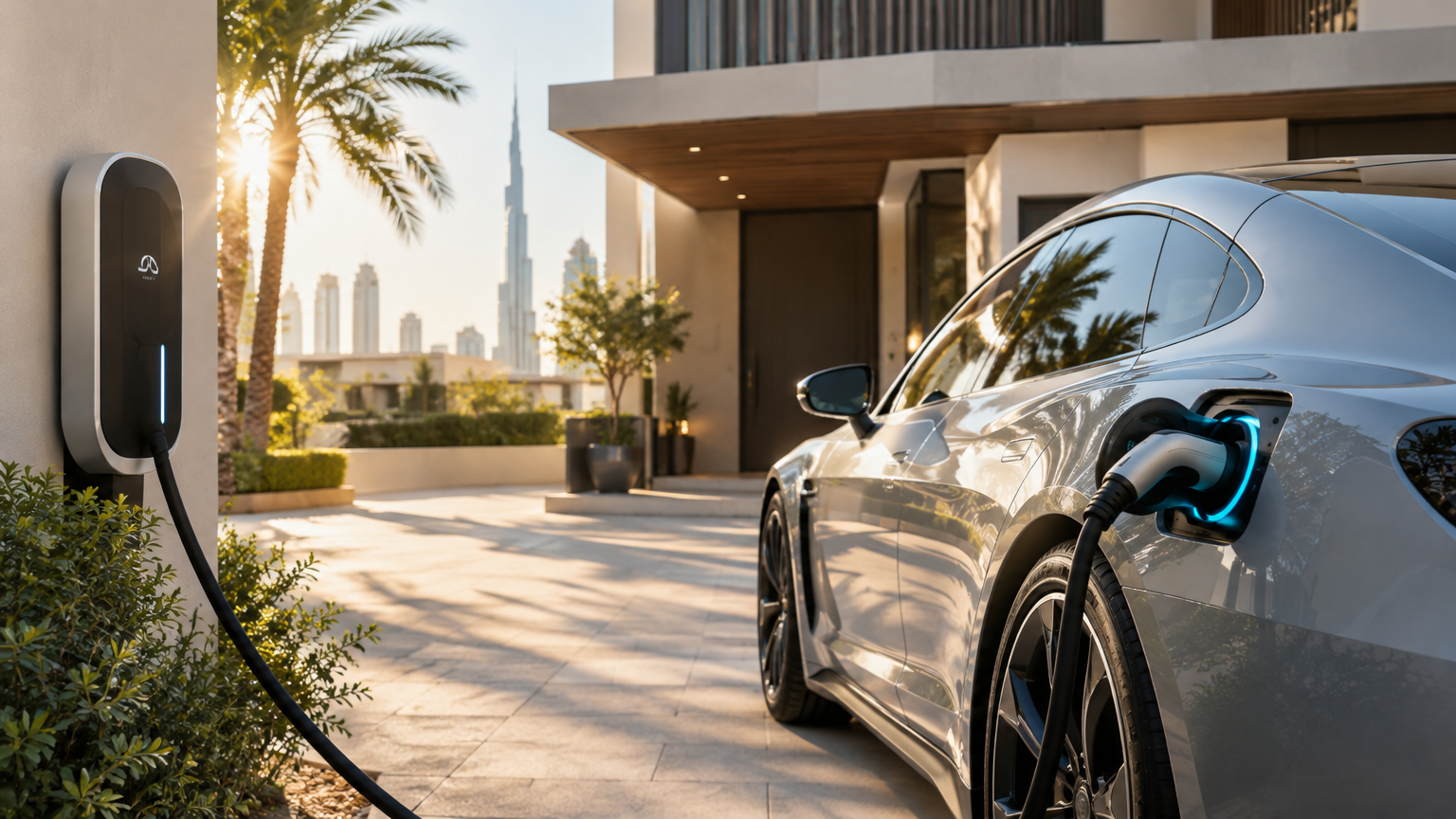
Moving to Dubai with an electric vehicle? Setting up EV charging Dubai new resident infrastructure requires several key steps before you can reliably power your car at home or on the road. This guide walks you through everything—from DEWA registration to home charger installation, with real costs, local rules, and a printable checklist you can follow today.
Quick Summary
- What this article covers: DEWA & RTA registration, third-party charging apps, Salik zones, No Objection Certificates (NOCs), and wallet top-ups.
- Why it matters: without these steps, you risk delays, unexpected fees, or inability to charge at home and in public.
- Key costs: AED 500 security deposit with DEWA, AED 2,400–8,000+ for home charger installation including electrical work.
- Local rules: apartment installations need landlord/developer approval and DEWA-certified contractors; public charging fees are set by DEWA with separate AC/DC rates.
- You’ll finish ready to charge at home, at DEWA stations, and using third-party networks—knowing exactly what to budget.
What You Need to Set Up Before Reliable EV Charging in Dubai
1. RTA Vehicle Registration → DEWA EV Account
- Once your EV is registered with the Roads & Transport Authority (RTA), DEWA automatically creates your “EV Green Charger” account. You’ll receive a welcome email with next steps. (dewa.gov.ae)
- If your vehicle is already registered, create the account via the DEWA website, DEWA Smart App, or DubaiNow App using UAE Pass. (dewa.gov.ae)
- You’ll pay a security deposit of AED 500 (for individuals and businesses; government entities are exempt) plus AED 20 courier delivery for your Green Charger Card. VAT applies. (dewa.gov.ae)
After payment and account activation, you’ll receive your EV Green Charger card within three working days. (dewa.gov.ae)
2. Understand Public Charging & Guest Mode Rates
- Registered users pay AED 0.70/kWh + VAT for AC charging and AED 1.20/kWh + VAT for DC fast charging. (dewa.gov.ae)
- Not yet registered or need immediate access? Use DEWA’s Guest Mode by scanning a QR code at any Green Charger station. Fill in basic details, pay via card or digital wallet, and cover only what you consume. (dewa.gov.ae)
3. Choose a Third-Party App or Charge Point Operator (CPO)
- Dubai has many licensed CPOs—including Fully Charged, GoCharge, UAEV, and Tesla Superchargers. Each operates its own app or platform. (dewa.gov.ae)
- Look for apps offering real-time charger availability, reservations, pay-by-app, and map integration. The Fully Charged app, for example, supports multiple providers and displays live station status. (play.google.com)
4. Salik Zones & Toll Gates Near Charging Hubs
- Salik is Dubai’s toll system. If your routes or planned charging stops are near Sheikh Zayed Road, Al Khail Road, or major bridges (Al Garhoud, Al Maktoum), you’ll pay tolls each time you use those roads. (salik.ae)
- Charging stations at petrol stations or malls along major roads often sit behind Salik gates. Budget for tolls in your regular commute costs.
5. Home Charging & NOC (Landlord / Developer / Building Management)
If you want a charger at your villa or apartment, you’ll typically need:
- A DEWA-approved electrical contractor to perform a load study and install according to DEWA’s EV Charging Technical Regulations (BS 7671, IET Code). (dewa.gov.ae)
- A No Objection Certificate (NOC) from your building developer or management (apartments/gated communities) or landlord (villas/rented properties) to approve physical installation, cable routing, and any structural work. (dewa.gov.ae)
- For villas, typical full installation (wall box charger, wiring, mounting, load management) costs AED 2,400–AED 5,000+ depending on cable distance, single or three-phase power, and breaker upgrades. (dubaismarthome.ae)
Apartments are more complex. You may need a dedicated meter, cable run from your unit or building’s main distribution board, and the NOC often includes the developer’s engineering approval. (dubaismarthome.ae)
6. Top Up Wallets & Set Payment Methods
- Your DEWA EV Green Charger account links to your monthly bill. You pay for charging sessions after they occur, but you must pay the initial deposit and card fees upfront. (dewa.gov.ae)
- Guest Mode charges are handled per session via credit/debit card or digital payment (Apple Pay, etc.) at QR code stations. (dewa.gov.ae)
- Third-party apps require you to load credit or wallet within the app. Most accept UAE bank cards and international cards; some offer bank transfers. Check each app’s payment options.
Printable Setup Checklist
| ✅ Step | What to Do | Documents/Action | Approx. Cost (AED) | Time Estimate |
|---|---|---|---|---|
| 1 | Register EV with RTA | Vehicle license & registration | — | Immediate (when purchase delivered) |
| 2 | DEWA EV Account activation | Use RTA link or DEWA/DubaiNow app with UAE Pass | AED 500 deposit + AED 20 delivery | 1–3 days (courier card delivery) |
| 3 | Learn public charging rates & Guest Mode | Review DEWA fee schedule; check AC/DC rates | — | 1 hour |
| 4 | Select CPOs & download third-party apps | Apps like Fully Charged, UAEV, Tesla | Possible wallet top-ups | Immediate |
| 5 | Salik tag & account (if using toll roads often) | Obtain Salik tag; load credit | AED 100 tag, plus AED 50–100 credit | Minutes to hours |
| 6 | Home charger NOC & electrical approval | Landlord / building / developer approval; DEWA-certified contractor | Villas: AED 2,400–8,000+; apartments: quoted after survey. NOC process fees: AED 200–500 | Survey + approval: 1–2 weeks |
| 7 | Top up wallets & payment setup | Set up payment methods in DEWA & third-party apps | Depends on charging frequency; minimums AED 10–20 | Instant when ready |
Cost Estimate: What You’ll Spend in AED
| Item | Low Estimate | Mid-Range | High / Complexity Case |
|---|---|---|---|
| DEWA EV account setup: deposit + card | ~AED 520 (AED 500 + AED 20) | Same | Same |
| Public charging (AC) per kWh | AED 0.70 + VAT (~5%) = ~AED 0.74/kWh | — | — |
| Public charging (DC) per kWh | AED 1.20 + VAT = ~AED 1.26/kWh | — | — |
| Salik tag & tolls | Tag: AED 100; tolls: AED 4–7 per gate | Varies based on daily trips through toll zones | High if many daily Salik gate crossings |
| Home charger installation (villa) | AED 2,400–5,000 | Includes short cable run, wall box, load study | Long cable runs, meter shifts, board upgrades: AED 6,000–10,000+ |
| Home charger in apartment | Survey + NOC: AED 3,000–6,000+ | More if dedicated meter or long cable tray runs needed | Complex buildings or older electrical panels may exceed estimates |
(Note: all costs as of mid-2026, based on market surveys and DEWA guidelines.)
Common Pitfalls to Avoid
- Ensure your charger box meets DEWA’s EV Charging Technical Regulations, including correct outlet type (Type-2 combo for most EVs), proper wiring, and full certification. (dewa.gov.ae)
- Check signal strength and accessibility of nearby charging stations (Downtown, JBR, Business Bay, Marina). A technically close charger may be blocked by traffic or limited access hours.
- In rented villas, clarify with your landlord who covers permanent installation costs, electricity increases, and whether you must remove the charger later. Recent cases show landlords approve installation only if tenants handle approvals and restoration. (thenationalnews.com)
- For apartments: confirm parking bay designation, cable run feasibility, electrical load capacity, and building management approval before committing.
The Minimum Setup for Reliable EV Charging
Here’s what you absolutely need so you can always count on charging options:
- EV registered with RTA, DEWA EV account activated, and Green Charger card in hand.
- Public charging network apps ready—DEWA plus at least one third-party provider—and Guest Mode set up for emergencies or immediate access.
- Salik tag and active account if your routes involve toll gates near charging hubs.
- Home charger for daily charging (villa or apartment) with all approvals and DEWA-certified installation, or a plan to use public chargers regularly.
Follow these four steps, and you’ll have reliable charging at home, work, and throughout Dubai—with clear knowledge of your costs.
Frequently Asked Questions
Q1: How long after registering with RTA can I