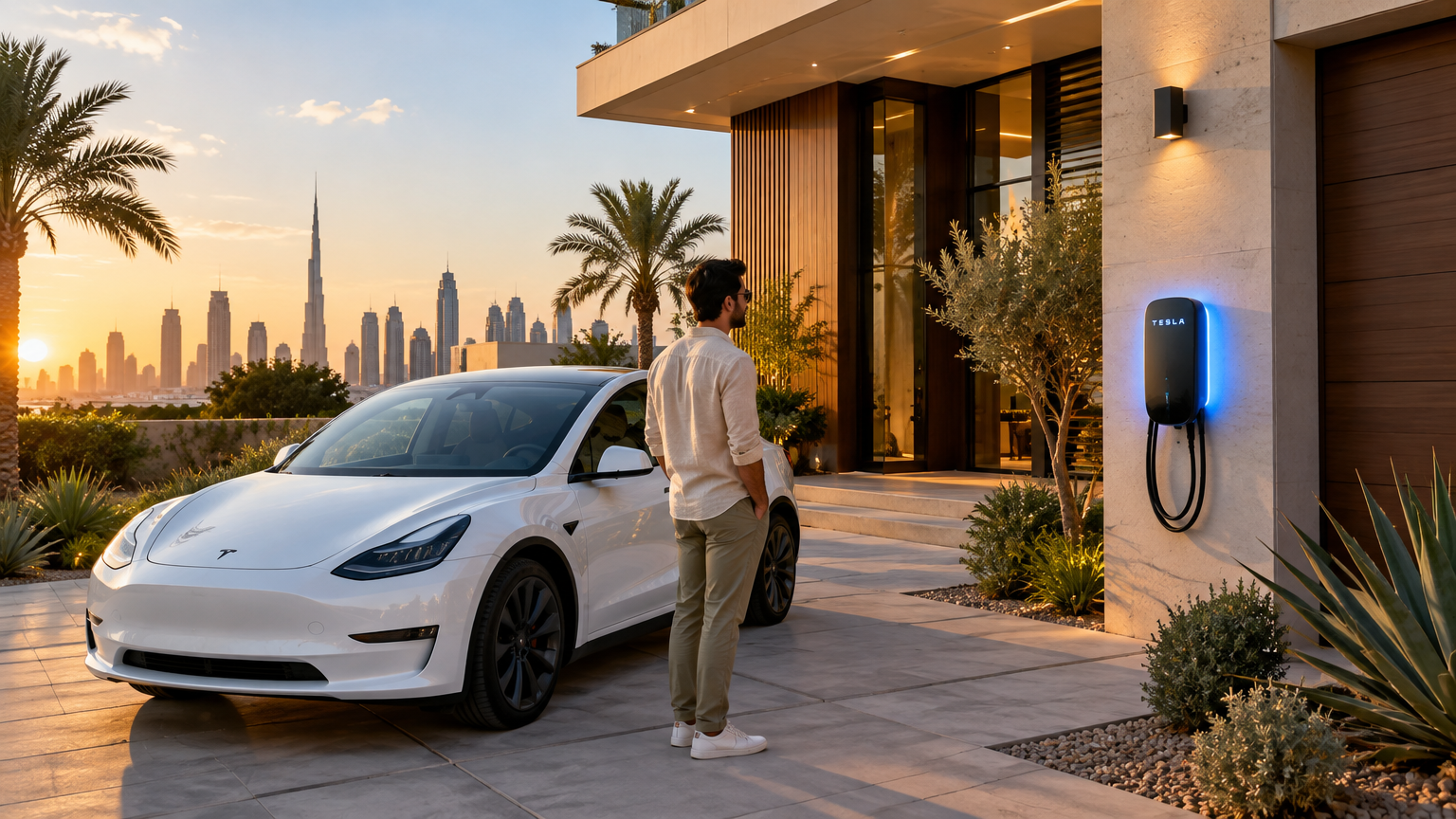
Installing EV charging Dubai villas requires careful planning, regulatory compliance, and the right contractor. This comprehensive 2026 guide walks you through every step — from assessing your electrical capacity and choosing between a 7 kW or 22 kW charger, to securing approvals, hiring certified installers, and registering with DEWA. Follow this checklist to avoid costly mistakes and ensure your home charger works safely and legally.
Quick Summary
- What this article covers: all the steps you need from assessing your electrical setup, choosing the right charger (7 kW AC vs 22 kW fast AC), securing approvals, and hiring the right contractor.
- Why it matters: missing just one item (earthing, NOC, cable run, DEWA registration) can cost thousands, delay installation, or even make your charger unusable.
- Key local rules: DEWA technical regulations, Dubai Building Code, developer or community NOCs, and contractor requirements.
- Cost ranges to expect: villa installs typically fall between AED 1,800–6,000+ for 7 to 22 kW chargers depending on scope.
- Actionable checklist format so you know the exact order of operations and what to check off before moving on.
What Exactly You Need to Do — Step-by-Step Checklist
These are the sequential steps you must complete. Skip any and you risk delays, extra costs, or non-compliance.
1. Assess Your Villa’s Electrical Capacity
| Task | Why It Matters | What to Check |
|---|---|---|
| Identify whether your villa has single-phase or three-phase supply | Single-phase supports ~6-7 kW chargers; three-phase supports 11–22 kW fast AC chargers. Many older villas have single phase. | Check your electricity bill or DB label |
| Check how much spare capacity you have on the existing Distribution Board (DB) | If your DB is already loaded (AC units, pool pumps, etc), you may need upgrades to avoid overload. | Review available breaker slots and current load |
| Determine distance from DB to the garage or parking bay | Longer cable runs = higher material & labour cost; possible voltage drop or safety issues. | Measure the route and note obstacles |
2. Decide on Charger Type: 7 kW AC vs 22 kW Fast AC
7 kW AC wall box (single-phase) is good for overnight charging, costs less, and requires simpler wiring. It’s ideal if spare capacity is limited or your EV doesn’t have a very large battery.
22 kW AC (fast charger) (three-phase) charges much faster and is future-proof. However, it requires heavier wiring, stronger protection, and possibly a panel upgrade. It suits newer, three-phase villas.
3. Understand DEWA Technical & Regulatory Requirements
- Comply with DEWA’s EV Charging Technical Regulations, which cover equipment design (weather rating up to 55°C, humidity limits, etc), IEC standard certifications, rated voltage (230/400V), and correct earthing.
- Check Dubai Building Code, especially Part G (utilities) and Part K (Villas) for charging point requirements.
- Use DEWA-approved electrical contractors only. DEWA views the charger as “behind your meter,” but the contractor must be DEWA-approved. Get proof in writing.
4. Get NOC / Developer or Community Management Approvals
- Even though you own the villa, developer or community management (e.g., Emaar, DAMAC, Arabian Ranches, etc.) often needs to sign off on wall penetrations, driveway cable routes, aesthetic changes, and safety of external conduits.
- If your villa is in a gated community or master-planned community, check for any community-wide requirements or restrictions.
5. Hire a DEWA-Approved Contractor & Perform Site Survey
- Ensure they are officially approved by DEWA. Ask for licences and references from past projects.
- During the site survey, check: DB condition, earthing/grounding status, cable route, protection devices (breaker, RCD), cable size, mechanical protection (conduit), and weather protection for outdoor parts.
6. Optional Electrical Upgrades
- Earthing / grounding: Critical but often missed. If your earthing is weak or not up to DEWA standard, upgrade it immediately.
- DB load upgrades: If spare capacity is insufficient, you may need to install a new circuit or sub-DB.
- Protection devices: Install an RCD (Residual Current Device) and a dedicated breaker sized correctly for the charger.
7. Procure the Charger & Decide on Cable & Mounting Details
- Choose your charger brand and specs: AC wallbox with Type-2 socket, smart features (app control, load balancing), and weather-proof rating if installed outdoors.
- Decide on cable length: leave enough slack for the routed path and note any obstacles. Longer runs increase material and labour costs.
8. Installation & Testing
- Your contractor will install the circuit from your DB, protection devices, conduit/trenching if needed, mount the wallbox, make connections, and test everything.
- Test for correct voltage, earth leakage, and load capacity. The contractor should produce a testing & commissioning certificate.
9. Register Charger with DEWA & Complete Your EV Account
- Register your EV via RTA and through DEWA digital channels (DubaiNow app or DEWA website). This gives you access to the Green Charger card, charger account, and enables smart billing and usage tracking.
- Ensure your charger is registered in DEWA’s system if required. Missing registration might prevent claiming warranties or using certain charging features.
10. Final Approvals & Ongoing Maintenance
- Submit your final report and test results to community management or your developer if needed.
- Keep all documentation: charger manuals, contractor licence, test certificate, and DEWA approvals.
- Plan periodic checks (e.g. yearly) for cable degradation, earthing integrity, and weather damage.
Common Oversights & How to Avoid Them
- Skipping earthing upgrades — often ignored but incredibly risky. If your earthing isn’t up to spec, DEWA can reject the setup.
- Ignoring cable length to parking bay — long indoor/outdoor runs cost extra for supply and labour; voltage drop is also a risk.
- Forgetting breaker/RCD protection — your install must have a dedicated breaker sized at ~125% of charger current.
- Failing to register with DEWA Green Charger account — without registration you can’t operate charging features properly and won’t get the Green Charger Card.
- Using a contractor who claims “DEWA-approved” without proof — always ask for their certificate and licence.
- Not getting developer/management NOC first — worst case: removal order, or you bear costs of reinstatement.
Timeline — What Order To Do Things In
- Assess electrical capacity and locate your meter and DB
- Decide on charger capacity (7 kW vs 22 kW)
- Check local regulations (DEWA technical regs, building code)
- Seek developer/community NOC
- Hire DEWA-approved contractor and schedule site survey
- Plan optional upgrades (earthing, DB capacity, cable route)
- Order your charger and accessories
- Install and test the system
- Register your EV and charger with DEWA
- Obtain final sign-offs and maintain the system
Costs & Pricing You Should Expect
| Item | Typical Cost for Villas in Dubai |
|---|---|
| 7 kW single-phase wall-box charger installed (short cable run, easy access) | AED 1,800–4,500 |
| 22 kW three-phase charger install (moderate cable, some upgrades) | AED 3,500–6,000 |
| Panel / DB upgrade (if needed) | Additional AED 1,000–3,000+ |
| Tesla Wall Connector unit + install | Approx. AED 2,800–5,000+ for typical villa setup |
| Large cable runs, external conduits, trenching, civil work | Adds significantly; could double the labour and material portion |
Frequently Asked Questions
Do I need approval from DEWA before buying a charger?
You don’t need DEWA’s approval before purchase, but you do need to ensure the charger and its installer comply with DEWA’s technical regulations. Registering your EV and charger in DEWA’s system after installation is necessary for official activation and usage tracking.
Can I install a 22 kW charger if I have single-phase supply?
No — single-phase supply in Dubai villas typically supports up to approximately 7–7.4 kW AC loads. For 22 kW you’ll need three-phase supply, a stronger DB, and possibly an upgraded meter and setup. Check your villa’s incoming supply type first.
What is the DEWA Green Charger Card, and do I need one at home?
The Green Charger Card is for DEWA’s public charging network. Although not always required for a private home charger, registering your EV and charger account with DEWA ensures full compliance and access to certain services and tariffs.
How long does installation usually take?
For a villa with everything in order (short cable run, no upgrades, fast NOC), installation takes 1–2 days including testing and paperwork. If upgrades or long cable routes are involved, expect several days to a week.
Who pays for the electrical upgrades or increased DEWA bill?
You do. All upgrades (earthing, DB, circuit protection) and any increase in energy consumption due to EV charging are your responsibility. Some villas may have incentives or subsidies but typically not in residential DEWA tariffs.
Ready to Get Started?
If you’re a villa owner in Dubai and ready to install your own EV charger, use this checklist to guide you through each stage. From assessing your power supply and selecting between a 7 kW or 22 kW charger, to getting NOCs, finding the right DEWA-approved contractor, and registering everything properly — this guide covers it all.
If you want help comparing specific charger models, evaluating your DB capacity, or finding certified contractors in your area, share your villa community (e.g. JBR, Business Bay, Arabian Ranches) and we’ll send tailored options. Get a free quote today.