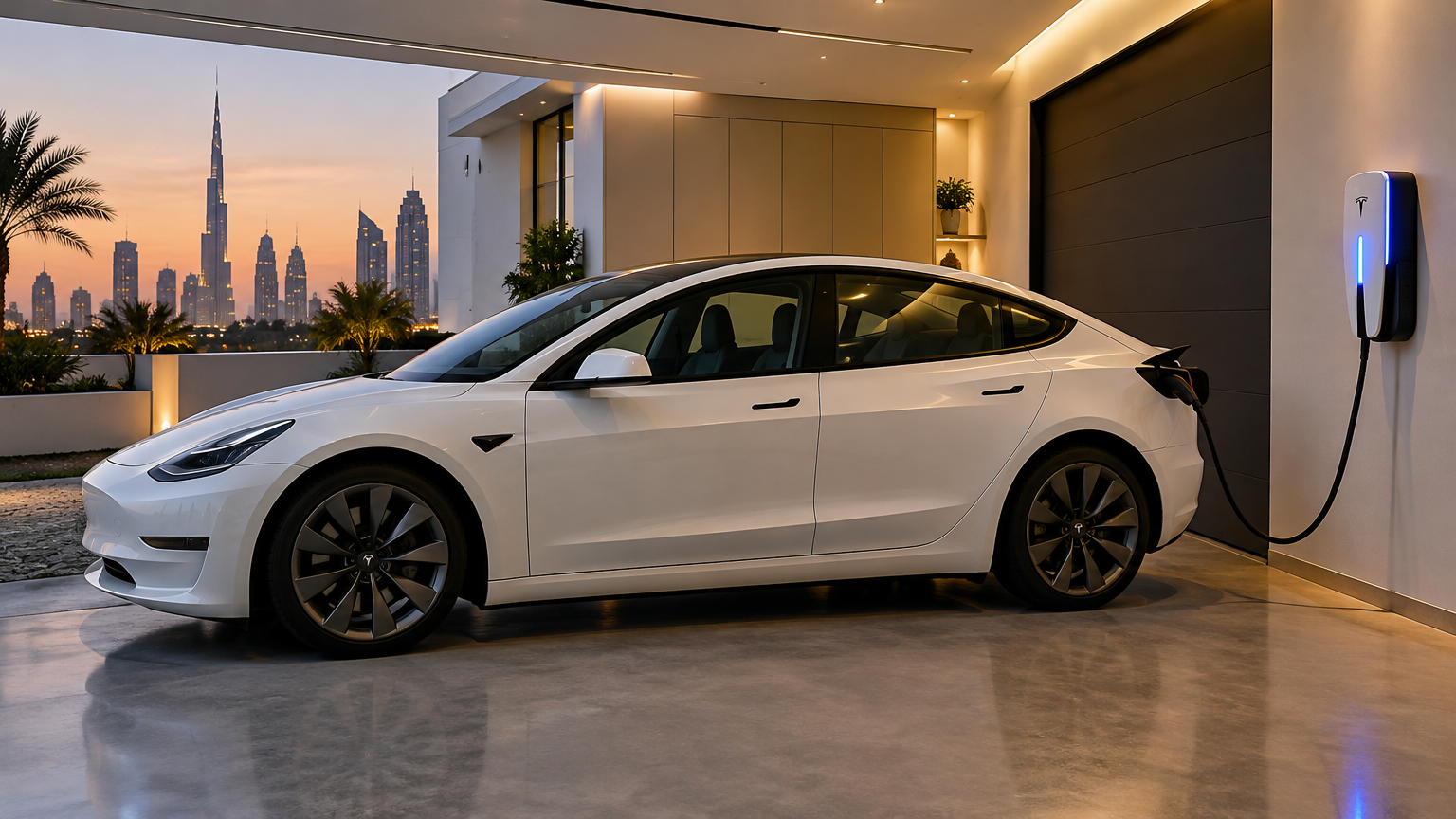
Here’s your complete how-to guide on overnight EV charging Dubai—everything you need to wake up to a full battery, avoid public stations, beat peak rates, and save money with real examples for Tesla Model 3 and BYD Atto 3.
Quick Summary
- Overview of how charging your EV overnight at home or in building parking beats public and fast charging for cost and convenience in Dubai.
- What to check: residential electricity slabs, charger power (kW), timer and smart charging settings, DEWA rules and approvals.
- Sample costs: estimated overnight cost in AED for Tesla Model 3 and BYD Atto 3 using real battery size, home and public rates.
- Local specifics: DEWA residential tariffs, public AC and DC rates under EV Green Charger network, rules for installing home chargers.
- Actionable checklist and comparison table to help you pick the cheapest and most convenient method for your situation.
Why Overnight Home Charging Wins in Dubai
Charging while you sleep—typically between 11 pm and 6 am—lets you fully charge at home electricity rates instead of paying premium DEWA public and fast-charging rates.
Residential electricity in Dubai uses a slab tariff system. Your cost per kWh depends on your total monthly usage. Higher consumption means a higher per-kWh price. DEWA’s EV Green Charger public AC rate is AED 0.70/kWh plus VAT. DC fast charging costs around AED 1.20/kWh plus VAT.
When you charge overnight at home, you typically use the lower residential slab rate. This can be AED 0.23–0.30/kWh depending on your monthly usage, plus fuel surcharge and VAT. The savings are significant.
Key benefit: You get convenience plus much lower cost per kWh. No queues, no DC-rate premiums, and a full battery when you wake up.
How to Choose and Set Up Overnight EV Charging Dubai
1. Confirm Your Battery Size and Charger Power
| Model | Battery Size (kWh) | Typical AC Home Charger Power |
|---|---|---|
| BYD Atto 3 | ~60.48 kWh | 7–11 kW AC (wall box or shared charger) |
| Tesla Model 3 | ~60 kWh | 7–11 kW AC common; higher if villa wiring supports it |
Both vehicles have similar battery capacities. This makes comparison straightforward when calculating overnight charging costs.
2. Understand DEWA Rules and Home Charger Installation
Any private charger installation—whether in a villa or building—must meet DEWA technical regulations. You need a DEWA-approved electrical contractor. The wiring capacity must support hours of continuous use.
Your charging draws electricity from your residential meter. DEWA does not offer a separate off-peak rate for home charging. The tariff is slab-based, not time-of-use. This means charging at night doesn’t automatically reduce your per-kWh cost compared to daytime charging from the same meter.
3. Use Smart Charger or Timer Settings
Set a timer in your home charger or use your EV app to schedule charging. Start after 11 pm and finish before early morning when you leave.
This avoids coinciding with DEWA’s peak load period. Peak demand typically occurs between 12–5 pm during hot months. While rates don’t change by hour, avoiding peak usage helps overall grid efficiency. You also reduce stress on your home’s electrical system.
4. Compare Home vs Public Costs
| Charging Option | Cost per kWh | Estimated Overnight Fill (60 kWh) | Total Cost |
|---|---|---|---|
| Home, lowest residential slab | AED 0.23 | 60 kWh | ≈ AED 14–18 |
| Home, mid-slab | AED 0.30 | 60 kWh | ≈ AED 18–20 |
| DEWA public AC Green Charger | ~AED 0.735 | 60 kWh | ≈ AED 45–50 |
| Public DC fast charger | ~AED 1.26 | 60 kWh | ≈ AED 75–80 |
These figures are approximate. Charging losses, charger efficiency, and battery state all affect real costs. For day-to-day use, you’ll often add 10–20 kWh overnight rather than charging from 0 to 100%.
Local Rates, Areas, and Regulations in Dubai
Residential Slab Tariffs (October 2026):
The lowest tier—0 to 2,000 kWh per month—costs AED 0.230/kWh before surcharges. Including fuel surcharge and VAT, this becomes AED 0.29–0.30/kWh. Higher usage slabs increase: AED 0.28, 0.32, and 0.38 per kWh depending on your consumption.
Public EV Green Charger Network:
AC public posts cost AED 0.70/kWh plus VAT. DC fast chargers cost AED 1.20/kWh plus VAT. These rates are significantly higher than home charging for most users.
Battery Sizes:
BYD Atto 3 carries approximately 60.48 kWh. Tesla Model 3 holds around 60 kWh in many UAE trims. This similarity simplifies cost comparisons between the two popular models.
Building-Specific Considerations:
If you live in JBR, Marina, Business Bay, or Downtown apartments, you need permission from property management to install chargers in shared parking. Wiring capacity must be adequate. Villa owners typically face fewer installation barriers.
Step-by-Step Setup for Maximum Savings
- Assess your monthly average electricity consumption to identify which DEWA slab you occupy.
- Install a 7–11 kW home charger in your parking spot (villa) or request building installation if permitted. Use a DEWA-approved electrician.
- Set your charger timer to start around 11 pm and stop early morning when you leave (6–7 am).
- Monitor battery state to avoid charging to 100% every time. Usually 80–90% is sufficient and reduces long-term battery wear.
- Use public AC only when away longer (office, malls). Avoid DC fast charging unless urgent—costs are much higher.
Frequently Asked Questions
Q: Does DEWA offer special off-peak night rates for EV charging at home?
A: No. Dubai’s DEWA residential electricity tariff is slab-based, not time-of-use. You pay based on how much you use in the month, not when you charge. Sleeping hours don’t lower your per-kWh cost.
Q: Can I charge at home on weekends or late at night without extra approval?
A: Yes, provided your charger is installed properly by a DEWA-approved contractor. If you live in an apartment building, property management must allow charging and your wiring must support continuous overnight use. DEWA has no time restrictions for residential charging.
Q: What is the cost to charge a Tesla Model 3 overnight at home?
A: If you fall in the lowest residential slab (AED 0.23/kWh plus surcharge and VAT ≈ AED 0.29–0.30), a full 60 kWh charge costs roughly AED 14–18. If your usage is higher and you hit the middle slab, expect AED 18–20.
Q: What about BYD Atto 3? Does it cost the same?
A: Nearly identical. With a battery of ~60.48 kWh, full overnight home charging costs around AED 18–20 in a higher slab, or AED 14–18 in the lowest tier. Public AC charging costs AED 45–55. DC fast charging runs AED 75–90.
Q: Can I use a public EV Green Charger AC station overnight instead of installing at home?
A: Yes—public AC posts work for overnight stays (near malls, residential clusters). However, they cost ~AED 0.70/kWh plus VAT, roughly two to three times your home rate in the lowest slab. It’s costlier and less convenient than home charging, but works in a pinch.
Ready to Get Started?
Comparing options for overnight EV charging? Whether you’re considering home installation, apartment building setup, or public chargers, finding the right solution saves money and hassle.
Get expert guidance on your overnight EV charging setup—request a free consultation today.
Reach out to contractors experienced with DEWA regulations. They can install home chargers in your area—Downtown, Business Bay, JBR, and beyond—and help configure timers and wiring for maximum savings. Don’t overpay for charging.
You now understand how to choose between home charger installation, smart overnight charging, or public Green Chargers. Balance cost, practicality, and battery care. Wake up to a full charge without paying premium rates or searching for public AC every night.