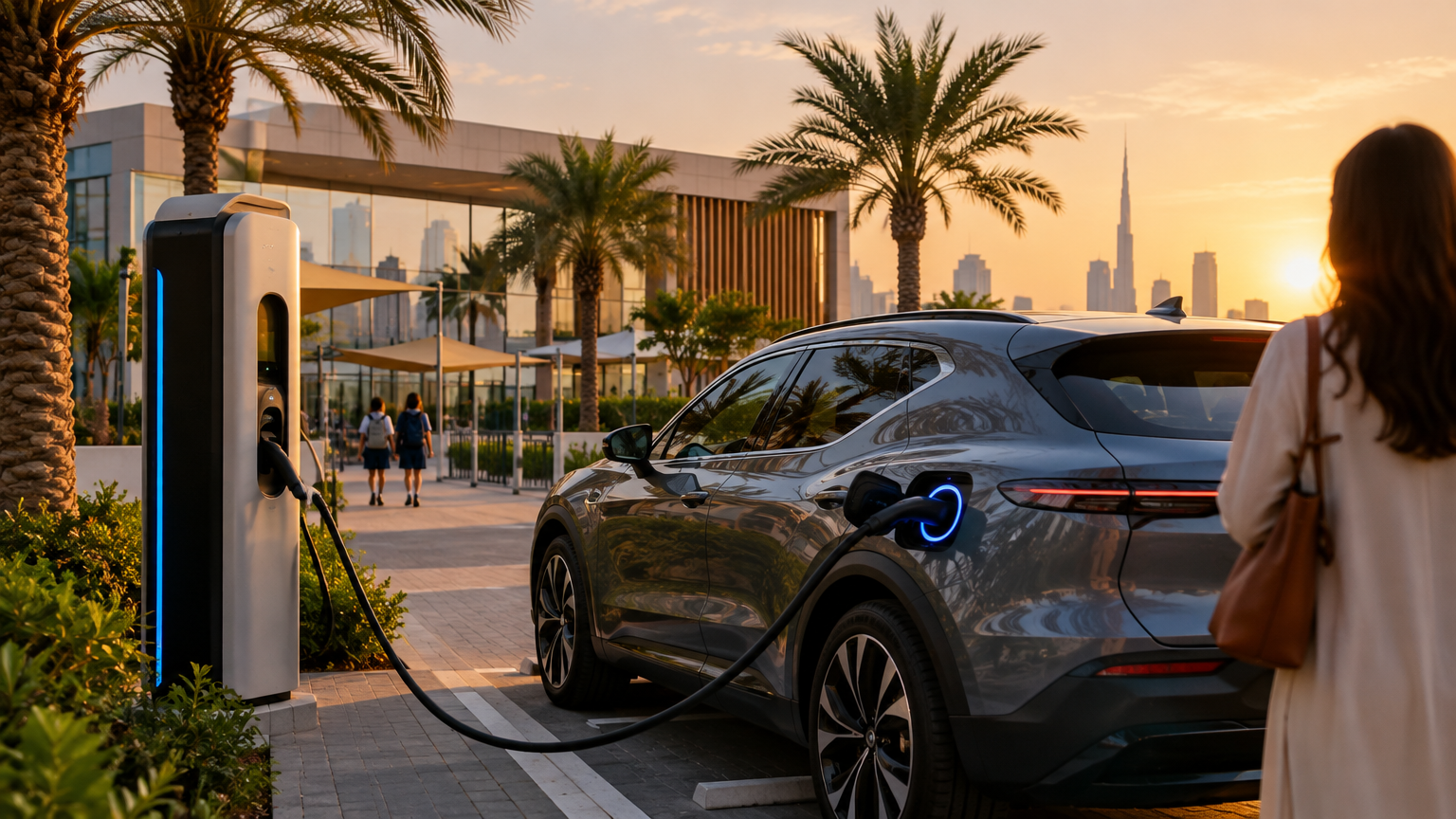
Discover how parents in Dubai can use school runs to charge their EVs efficiently. This guide maps EV charging Dubai schools near Jumeirah, Mirdif, and Arabian Ranches—showing you which stations work best during 30-minute pickup windows, current pricing, and reliability tips.
Quick Summary
- We map EV charging station options within 5 minutes of school clusters in Jumeirah, Mirdif, and Arabian Ranches, ideal for 30-minute school runs.
- We review DEWA Green Charger rates (AC vs DC, cost per kWh + VAT) to see when quick top-ups make financial sense.
- We compare session management apps (registered account vs guest mode)—especially handy when you can’t stay by the car.
- We examine reliability issues: which stations you can count on, charger types, and downtime risks.
- Final verdict: Can you meaningfully charge in 30 minutes, and which stations are reliable enough to plan daily around?
School Run + EV Top-Ups: The Reality Check
Driving parents in Dubai spend 20-40 minutes total for pickup and dropoff. If you detour slightly to a charging station, a 30-minute window gives you roughly 15-25 minutes of actual charging time. Here’s what that adds to your range:
- AC charger (22 kW): adds around 20-40 km of range (5-10 kWh)
- Fast DC charger (50-150 kW): adds 60-90 km of range (15-25 kWh)
Yes, it’s possible—but only with the right station. You need one that’s fast enough, available, reliable, and affordable.
DEWA Green Charger Rates: What You’ll Actually Pay
| Charger Type | Price per kWh (before VAT) | With VAT (5%) | Cost per Minute Estimate* |
|---|---|---|---|
| AC charging | AED 0.70/kWh | ≈ AED 0.735 | At 22 kW: ~ AED 0.27 per minute |
| DC fast / ultra-fast | AED 1.20/kWh | ≈ AED 1.26 | At 50-150 kW: ~ AED 1.05-3.15 per minute |
*Estimate assumes charger power and battery can accept full power.
For a typical 30-minute school run using AC and charging 25 minutes, expect to pay around AED 6-7 (roughly 5-8 kWh). With DC fast charging for 10-15 minutes, budget AED 12-20.
You save money compared to petrol-based travel, especially for mid-range trips. However, DC charging costs significantly more per minute—use it only when necessary.
Charger Speeds: Which Type Fits Your School Run?
| Charger Type | Typical Power | Best Use for Pickup Windows | Availability Near Schools |
|---|---|---|---|
| AC public charger (22 kW Type-2) | ~22 kW | Adds modest range buffer; good if you charge while handling other tasks | Several in Mirdif, outskirts of Jumeirah, near shopping centres |
| DC fast charger (50-60 kW) | Medium speed | Adds meaningful charge in 15 minutes; ideal for quick top-ups | Found at fuel stations and major road junctions near Arabian Ranches and JBR |
| Ultra-fast (100-150 kW+) | High speed | Shortest charging time but higher cost; better for major needs than daily top-ups | Less common near schools; mainly in malls or major hubs |
Where to Charge: Reliable Stations Near Your School
| Area | Notable Schools Nearby | Charging Stations Within 5-Minute Drive | Charger Types & What You Need to Know |
|---|---|---|---|
| Jumeirah | Jumeirah English Speaking School (JESS), Dubai British School, Montessori nurseries | EV Green Charger at 20A Street, Al Manara; Jumeirah Street stations; malls like Mall of the Emirates have Tesla and public chargers | Mostly AC chargers (22 kW), some DC fast options. Availability drops during school hours. Some chargers sit in private parking—verify access before visiting. |
| Mirdif | Uptown School, Nord Anglia, Mirdif City Centre nurseries | Multiple DEWA EV Green Charger 22-kW AC units in sport society zones; DC and 60 kW options at ADNOC/ENOC stations near main roads | Good overlap of charger locations. DC units exist but are fewer in number. Drive time is minimal with route adjustments. Use live maps to check availability. |
| Arabian Ranches | Ranches Primary, JESS Arabian Ranches campus, community nurseries | Arabian Ranches Golf Club has BMW charging station; AC GreenChargers in Town Centre and near Ranches Primary; DC fast options available at petrol stations just outside gates | Best results if you arrive early. AC chargers provide modest top-ups. For DC, check petrol stations outside the gated community. BMW charger likely restricted to members. |
Payment & Session Management: Guest Mode vs. Registered
DEWA Green Charger offers two payment methods:
Registered User Account
Pay an AED 500 one-time refundable security deposit plus a delivery fee. Use your DEWA account or physical card. This option works best if you charge frequently. You get better session tracking and transparency for managing your charging habits.
Guest Mode
Scan the QR code, select your charging duration, and pay via credit card or Apple Pay. Your charge starts immediately and stops when consumption reaches your payment. This suits quick top-ups during school runs perfectly.
Both methods work with apps (DEWA Smart App, ChargeMigo, SHABIK) that show:
- Live charger availability—is it free or occupied right now
- Charging completion notifications so you don’t forget your car
- Remote session control to start or stop charging from your phone
If you’re managing children during pickup, guest mode plus app notifications saves you from returning to find the charger occupied or your car still charging.
Reliability & Real-World Challenges
Before committing to daily school-run charging, know these common issues:
Equipment Downtime
Chargers go offline for maintenance or malfunction. AC bays especially suffer from disruptions. Some stations sit in government compounds that close early—well before evening school pickups.
Queueing & Blockages
Chargers get blocked by fully-charged cars left sitting. Demand spikes during school start and end times, creating waits you won’t have time for.
Connector Compatibility
Most DEWA chargers use Type-2 and CCS2 connectors. If your EV uses CHAdeMO or another standard, confirm that adapter or charger type is available in your area before planning around it.
What Actually Works
Build these habits for reliable charging:
- Check the DEWA app and live map tools (ChargeMigo, SHABIK) immediately before heading out
- Prioritise chargers at shopping centres and major roads—they’re better maintained
- Always have a backup plan: charge at home overnight or use a charger near your workplace
The good news: DEWA has expanded to over 400 public EV Green Chargers across Dubai. The network’s downtime has improved from roughly 9% in late 2021 to about 2% by late 2024, showing real progress in reliability.
Frequently Asked Questions
Q: Will I get enough range in a 30-minute school pickup?
Yes. A DC fast charger (50-150 kW) delivers 40-80 km of range in 10-15 minutes. A 22 kW AC charger adds 15-30 km in the same period. Both are meaningful boosts for daily commuting.
Q: Are DEWA rates fixed or can they change?
DEWA’s AED 0.70 (AC) and AED 1.20 (DC) per kWh rates are federal minimums set by Cabinet Decision 81 of 2024, plus 5% VAT. All DEWA Green Chargers must charge at least these rates. Some third-party CPOs for DC may charge slightly more.
Q: Should I register or stick with Guest Mode?
Register if you plan frequent school-run charging. It streamlines sessions and gives better tracking. Guest Mode works fine for occasional top-ups—just scan the QR code and pay instantly—but register if you become a regular user.
Q: What makes a station reliable for daily planning?
Check these factors before committing:
- Charger speed (AC vs DC fast)
- Live availability via DEWA, ChargeMigo, or SHABIK apps
- Public access (not restricted to compounds or members only)
- Operating hours that match your pickup schedule
- User reviews and maintenance history if available
Q: Are there hidden fees beyond the kWh cost?
DEWA regulations require transparent pricing: electricity, fuel surcharge, and operator fees must be clearly shown. No subscription fees are allowed. Watch for overstay charges if your car remains plugged in beyond the session end time.
Get Started With EV Charging at School Pickup
Ready to make school runs work for your EV? Follow these steps:
- Download the DEWA Smart App and local tools like ChargeMigo or SHABIK today
- Map stations near your children’s schools—mark which are AC, which are DC, and their typical availability
- Test during real pickup times to see capacity and demand in practice
- Build a backup plan: know a second charger location in case your first choice is occupied
With smart planning and the right station selection, you can meaningfully charge during school runs. The key is not relying on a single charger—always have an AC backup near home or work. Ready to find the best EV charging solution for your routine? Get a free quote today, and we’ll help map reliable stations specific to your routes, suggest ideal charger types for your vehicle, and calculate daily cost versus benefit.