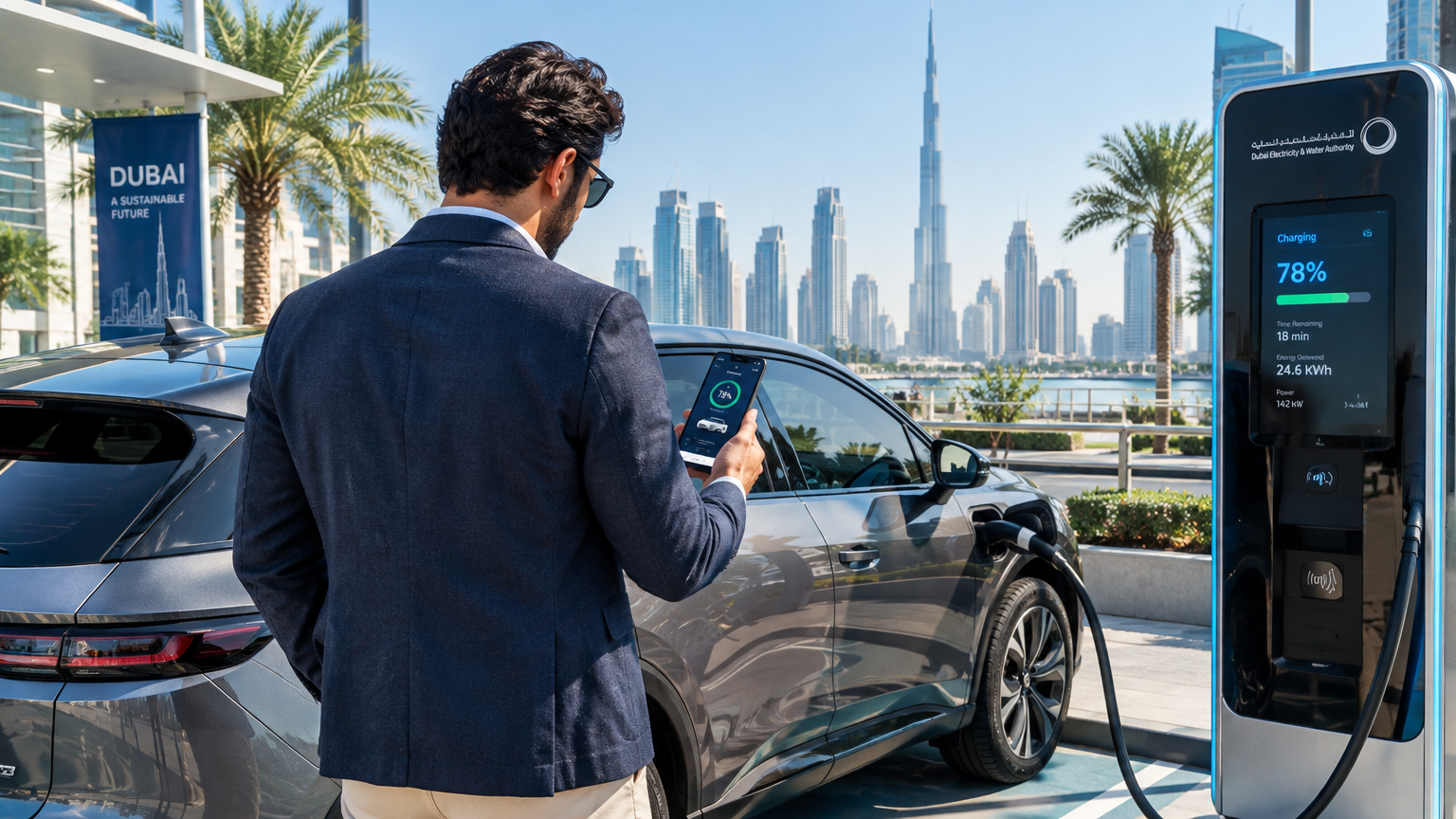
Dubai’s EV charging landscape is expanding rapidly, but many owners make costly mistakes. This guide covers the biggest EV charging Dubai mistakes to avoid — from relying on a single network to ignoring local regulations. Learn practical solutions tailored to Dubai’s power tariffs, climate, and compliance rules so you can charge efficiently and legally.
Quick Summary
- Five common mistakes Dubai EV owners make: relying solely on the DEWA Green Charger app, picking the wrong charger type, skipping NOC/permits for home installations, underestimating heat-related range loss, and paying peak rates by charging at bad times.
- Why it matters: each mistake adds cost, time, or risk — all avoidable with proper planning.
- What you’ll learn: practical solutions specific to Dubai’s power tariffs, regulations (DEWA, Dubai Building Code, RTA), climate, and network options.
- How you’ll be ready to act: confidently choose a charger, schedule charging, avoid legal issues, and reduce operating expenses.
Dubai’s EV-Charging Ecosystem in 2026
Dubai’s EV charging network is growing fast. DEWA’s EV Green Charger initiative now operates over 400 public chargers. Private operators like ENOC EVgo, UAEV, and ADNOC e-Tap are expanding their networks across the emirate.
You’ll encounter multiple connector types: Type 2, CCS2, and some GB/T (Chinese standard). Understanding which one your vehicle uses is essential.
Current pricing: AC charging costs AED 0.70/kWh plus VAT, while DC fast charging runs AED 1.20/kWh plus VAT under DEWA’s tariff structure.
Strict regulations apply to both public and private chargers. The DEWA EV Charging Technical Regulations (version 1.0, May 2025) set design criteria, connector types, temperature limits, and installation approvals. All EVSE (Electric Vehicle Supply Equipment) must comply.
Top 5 EV Charging Dubai Mistakes & How to Fix Them
Here are the most common errors owners make—and exactly how to avoid them.
Mistake #1: Relying Only on the DEWA Green Charger App
What happens: You plan routes assuming the DEWA Green Charger network will always have available chargers with the right connector type for your vehicle.
Why it hurts:
- Chargers may be in use, out of service, or unavailable in your area.
- You end up paying more at private stations or waiting longer.
- Network gaps exist in areas like Jebel Ali and the outskirts.
Dubai-specific reality: While DEWA has expanded to over 1,000 outlets, third-party networks like ADNOC e-Tap and EVgo are quickly filling gaps—especially fast chargers on highway routes and at ENOC stations.
The fix:
- Install multiple charging apps. Beyond DEWA EV Green Charger, add ENOC EVgo, UAEV, and ADNOC e-Tap. Keep them updated for real-time availability and mapping.
- Install a home charger as backup. Even with plentiful public charging, home charging overnight covers your daily miles and reduces public network dependency.
- Check connector compatibility. If your car uses GB/T (Chinese standard), you’ll need an adapter. Most UAE public networks use CCS2 or Type 2.
Mistake #2: Choosing the Wrong Charger Type
What happens: You install a powerful charger (say, 22 kW AC or high-power DC) only to discover your vehicle’s onboard charger limits it to 7 kW AC, or your battery cannot safely handle fast DC charging.
Why it hurts:
- You overspend on a charger that won’t deliver faster charging.
- Risk of overheating and premature battery degradation.
- Poor performance during Dubai’s intense summer heat.
DEWA’s requirements: Public chargers must use Type-2 (AC) and CCS2 (DC). Private installations can use other connectors if approved by DEWA. Importantly, charger performance is limited by ambient conditions—above 55°C, performance drops significantly.
The fix:
- Check your vehicle’s specifications first. Look up your EV’s maximum AC and DC charging inputs. If your onboard charger accepts only 7 kW, a 22 kW wall box won’t speed things up.
- Match charger type to your routine. Local driving around Downtown, Business Bay, or Marina? A 7–11 kW AC charger may be perfect. For cross-emirate travel or desert trips, prioritize DC fast-charging access.
- Use DEWA-approved equipment and installers. This ensures your system is safe, efficient, and fully compliant with technical regulations.
Mistake #3: Skipping NOC and Permits for Home Installation
What happens: Homeowners or apartment dwellers begin installing home chargers without obtaining a No Objection Certificate (NOC) or approvals from building management, DEWA, Dubai Municipality, or property owners.
Why it hurts:
- DEWA or building management can disable or remove your charger.
- Safety hazards develop: insufficient electrical load, wiring problems, inadequate ventilation.
- You face potential fines, delays, or forced removal.
Dubai’s legal framework:
- Directive No. 1 of 2017 requires DEWA approval for any EV charging station, public or private.
- Dubai Building Code, Part G.5.2, mandates prior DEWA approval, a dedicated circuit, proper ventilation space, and correct connector and mode.
The fix:
- Hire a DEWA-approved contractor or electrician. They understand all requirements and can navigate the approval process.
- Obtain NOC from building management (for apartments), then submit your application to DEWA. Villa owners usually have a simpler process unless adding significant electrical load.
- Verify your building’s load capacity. If your total electrical draw is too high, DEWA may require a service upgrade or charger current limitation.
Mistake #4: Underestimating Summer Heat Impact on Range
What happens: You assume advertised range—300–450 km—is realistic even when summer temperatures hit 40–50°C and air conditioning runs constantly.
Why it hurts:
- You run out of charge unexpectedly.
- You’re forced into expensive DC charging sessions.
- Battery stress accelerates degradation.
Real Dubai data: On typical summer days above 38°C, range loss from cooling demand and battery inefficiencies can reach 25–30% or higher. Vehicles with better liquid-cooling systems perform better than those with air cooling.
The fix:
- Plan using realistic range, not maximum claimed range. If you typically use 80% of battery and subtract an additional 25–30%, calculate what you genuinely need between charge stops.
- Charge during cooler parts of the day. Evening or early morning charging starts your battery cooler. Park in shade or covered areas when possible.
- Pre-condition your cabin while still plugged in. Many EVs let you use grid power for AC cooling before departure, preserving battery energy.
Mistake #5: Charging During Peak Hours Without Scheduling
What happens: You plug in as soon as you arrive home in the evening—often during higher DEWA tariff periods. Equipment works harder, efficiency drops, and your electricity bill climbs.
Why it hurts:
- Your monthly electricity bill increases noticeably.
- Chargers and wiring generate excess heat under peak loads.
- Charging is slower when the grid is stressed.
DEWA’s tariff structure: Residential customers pay AED 0.230/kWh for the first 2,000 kWh monthly, then AED 0.280/kWh for usage between 2,001–4,000 kWh, with higher rates above that. Summer peak hours (12pm–6pm, June–September) add strain to the grid and your costs.
The fix:
- Set chargers to auto-schedule overnight or off-peak hours (roughly 10pm–7am) for lower rates and cooler operating temperatures.
- Monitor your consumption slabs. Try to stay within lower slabs by spreading usage across the month.
- Use smart chargers with timers and current limiting. Remote-start features let you charge during the cheapest windows automatically.
Comparison Table: Mistakes and Solutions
| Mistake | Impact | Solution |
|---|---|---|
| Relying only on DEWA Green Charger | Downtime, coverage gaps, wrong connectors, wasted time and money | Install multiple network apps; verify plug compatibility; have home charger backup |
| Wrong charger type or overspecification | Wasted investment, no speed gain, battery and cooling stress | Match charger power to vehicle specs; use DEWA-approved EVSE; understand onboard charger limits |
| Skipping NOC and approvals | Charger removal, safety hazards, fines, liability | Get building consent; obtain DEWA approval; hire DEWA-approved contractors; verify electrical load |
| Underestimating summer range loss | Range anxiety, unplanned expensive charging, battery stress | Use realistic range estimates; charge during cooler hours; precondition cabin; account for AC load |
| Charging during peak hours | Higher tariffs, inefficiency, overheating, grid stress | Schedule overnight charging; avoid midday loads; use smart timers; monitor slab usage |
Local Regulations and Compliance
Understanding Dubai’s regulatory environment is essential for trouble-free EV charging.
- DEWA EV Charging Technical Regulations (v1.0, May 2025) define design standards for all chargers, including connector types (Type-2 for AC, CCS2 for DC on public networks), safety protocols, ambient temperature limits, and humidity requirements.
- Dubai Building Code, Section G.5.2, specifies requirements for private EVSE installations, including NOC requirements, dedicated circuits, ventilation, permitted charging modes, and physical space standards.
- Directive No. 1 of 2017 by the Supreme Council of Energy mandates that all organizations installing EV charging infrastructure obtain approvals from DEWA and coordinate with RTA and Dubai Municipality.
Frequently Asked Questions
Do I need DEWA approval for a home charger in my villa?
Yes. Even villas require DEWA approval if your charger installation increases the electrical load beyond your meter’s capacity. Work with a DEWA-approved contractor to ensure compliance with technical regulations. Apartment dwellers also need building management and owners’ association consent.
Can I rely solely on DEWA Green Charger stations?
Technically yes, but it’s risky. Signing up with private networks like ADNOC e-Tap or EVgo provides backup access when DEWA chargers are busy or out of service—and they often have faster DC chargers on highways between emirates.
How much range do I lose in summer around Dubai Marina?
Real-world testing shows 25–30% or greater range loss on days above 38–40°C with heavy air conditioning use. Hill driving, highway speeds, and stop-start traffic in malls make it worse. Always leave a safety margin in your trip planning.
What’s the cheapest time to charge at home?
Overnight or early morning (approximately 10pm–7am) offers the lowest rates and coolest operating temperatures. Avoid afternoon hours (12pm–6pm), especially in summer. Also monitor your monthly consumption slab to prevent higher per-kWh rates.
How do I know if my EV supports DC fast charging?
Check your vehicle’s technical specifications for AC and DC charging inputs and connector types. Look for a CCS2 port, which indicates DC capability. Vehicles from China may use GB/T connectors and require an adapter, as UAE public DC networks primarily support CCS2.
Take Action Today
You now understand the five biggest EV charging Dubai mistakes and exactly how to avoid them. Whether you’re selecting a home charger, comparing network options, or planning your budget, don’t delay your decision.
Get a free quote today to see charging solutions tailored to your vehicle, daily routes, and home setup. Whether you live in Al Barsha, JBR, Business Bay, or Dubai Marina, there’s a smart, compliant, cost-efficient charging plan waiting for you.