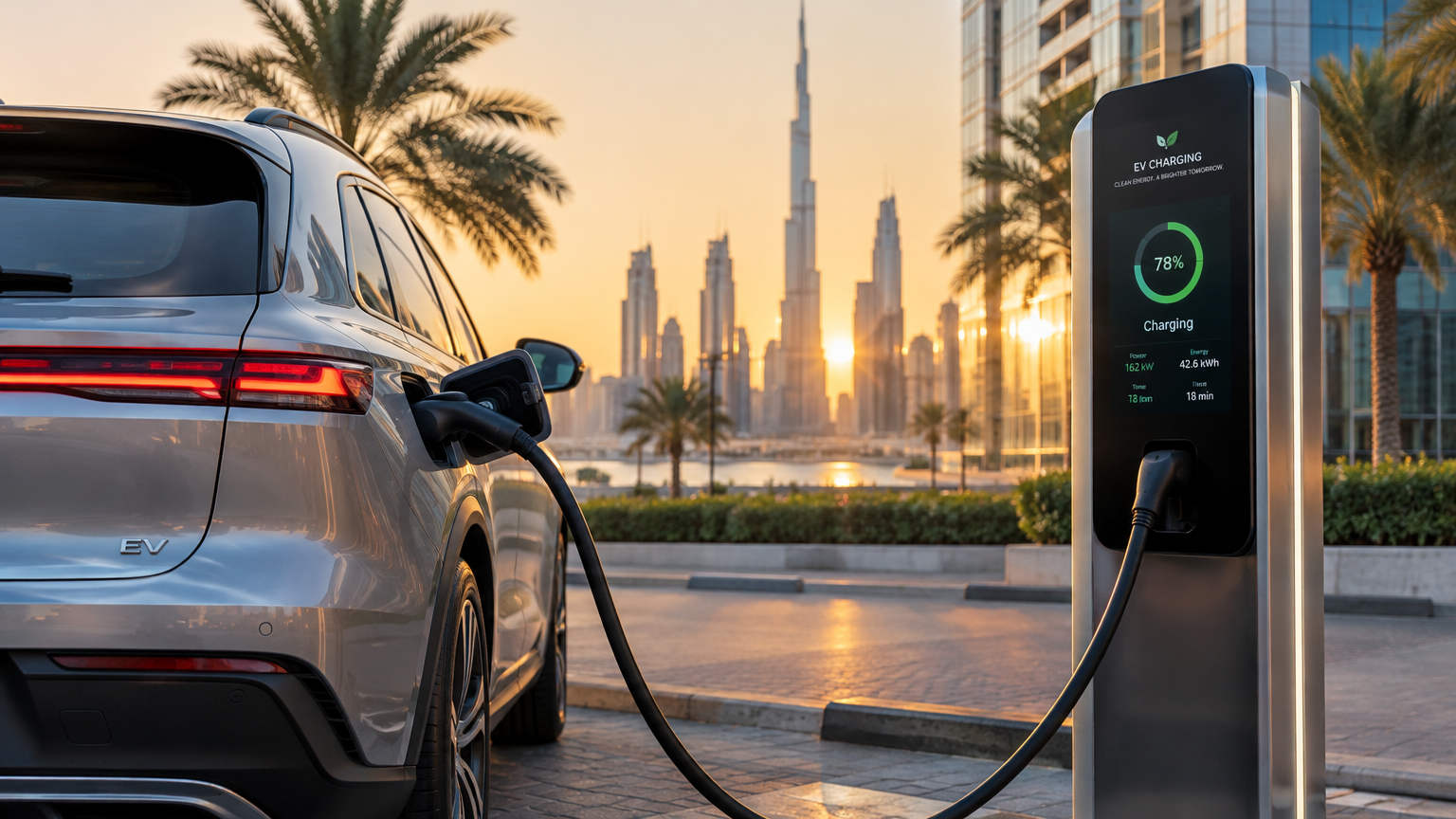
EV charging Dubai expats need depends on whether you’re renting, own your property, or plan a short stay. This guide covers everything expats in Dubai must know: opening a DEWA account, obtaining permits, installing home chargers, comparing costs with public stations, and navigating landlord permissions. By the end, you’ll understand your options and total costs in AED.
Quick Summary
- Essential documents for expats (tenants or owners) to open DEWA accounts and secure EV charger permits
- How to activate a DEWA account if you’re renting, and what visa or residency status means for eligibility
- What to do when your building refuses installation, plus your legal rights and alternatives
- Cost comparison in AED: home charger installation versus public charging stations, especially for short-term leaseholders
Understanding DEWA Accounts & Documents for Expat EV Charging Dubai
Who qualifies for a DEWA account?
A valid DEWA (Dubai Electricity & Water Authority) account is essential for both home EV charging and managing utilities.
If you’re a tenant: You can open a DEWA account if you have a valid Ejari-registered tenancy agreement (valid for at least one month), your Emirates ID, and a passport or visa copy. (dewa.gov.ae)
If you’re an owner: DEWA requires your title deed instead of a tenancy contract. (dewa.gov.ae)
Residency status: Expats on residency visas have a straightforward approval process. If you’re on a short-term stay visa without residency, DEWA may require passport and visa copies to verify your legal stay. A valid Emirates ID speeds up approvals significantly. (dewa.gov.ae)
Documents Checklist for DEWA Account & Home Charging
Use this checklist to prepare your documents for EV charging Dubai expat applications:
| Requirement | Owner | Tenant / Renter |
|---|---|---|
| Emirates ID | ✓ | ✓ |
| Valid visa or passport copy | ✓ | ✓ |
| Ejari-registered tenancy contract | — | ✓ |
| Title Deed | ✓ | — |
| Trade License | ✓ (commercial use) | ✓ (commercial use) |
| Landlord No Objection Certificate (NOC) | Only if building policy requires | Usually required |
| Building NOC (apartments) | — | ✓ |
Landlord or Building Manager NOC: Many residential buildings or homeowners’ associations require a No Objection Certificate before you install anything on common walls or parking bays. This is often the biggest hurdle for apartment dwellers.
How to Open a DEWA Account as a Tenant: Step-by-Step
- Register your tenancy with Ejari and ensure your agreement remains valid throughout your stay.
- Gather all required documents: Emirates ID, passport or visa copy, tenancy contract, and landlord NOC if your building requires one.
- Apply online via DEWA’s portal, DubaiNow, or UAE PASS for “Move-in / Activation of Electricity & Water.” Upload your Ejari registration and ID. (dewa.gov.ae)
- Pay the security deposit: typically AED 2,000 for a flat or AED 4,000 for a villa, depending on property type. (dewa.gov.ae)
- Confirm account activation and decide between home charging setup or applying for the “Green Charger” card to use DEWA’s public AC and DC stations. (dewa.gov.ae)
What to Do If Your Building Refuses EV Charger Installation
If building management blocks your charger installation, try these approaches:
- Request specific reasons: Ask for structural safety concerns, parking ownership disputes, or electrical load limitations in writing.
- Propose shared solutions: Offer to cover wiring costs within common parking if other residents share the infrastructure.
- Pursue legal options: RERA (Real Estate Regulatory Agency) governs leases and building regulations. They can enforce fair use rights outlined in your Ejari agreement.
- Use public charging temporarily: Highly practical for short-term leases while you resolve permissions issues.
Home Charger vs. Public Charging Costs (Dubai 2026)
Home Installation Expenses
Villa or townhouse (7 kW or 11 kW wallbox): Installation costs AED 1,800–6,000+, depending on cable distance and electrical specifications. (bestimate.ae)
Apartment parking bay: Expect AED 4,000–9,000. Costs rise due to building permissions, longer cable runs, shared infrastructure upgrades, and possible distribution board modifications. (chargerhouse.ae)
Additional fees: DEWA permit and inspection run AED 500–1,200. Building NOC for apartments typically costs AED 100–500. (chargerhouse.ae)
Running Costs at Home (per kWh)
Residential DEWA electricity rate: AED 0.29–0.44/kWh (before VAT), depending on your monthly usage slab. Charging appears on your regular DEWA bill. (abbastechnical.ae)
Public Charging Tariffs
DEWA’s EV Green Charger rates (effective September 30, 2024, under Cabinet Decision No. 81 of 2024):
- Visitors and unregistered users: Can access public AC and DC chargers with standard fees.
- Registered Green Charger users: AED 0.70/kWh (+VAT) for AC charging; AED 1.20/kWh (+VAT) for DC fast charging. (dewa.gov.ae)
Cost Examples
| Scenario | Energy Used | Home Charging Cost* | Public AC Charging | Public DC Fast Charging |
|---|---|---|---|---|
| Full charge (0–100%) | 70 kWh | AED ~20.30 | AED ~49 | AED ~84 |
| Quick top-up | 20 kWh | AED ~6 | AED ~14 | AED ~24 |
*Figures before VAT. Actual bills may increase if your total household energy consumption pushes you into a higher DEWA tariff slab.
Short-Term Lease Considerations for Expats
If you’re staying 3–6 months, renting a serviced apartment, or hesitant about building modifications, public charging offers clear advantages:
- Flexibility: Pay only for what you use with no landlord approval hurdles or structural changes required.
- Registration options: Sign up with DEWA Green Charger or use public CPO (Charge Point Operator) networks via apps or RFID cards.
- Network coverage: Public chargers concentrate in JBR, Marina, Business Bay, and Downtown, though peak-hour queues occur frequently.
- Cost analysis: For daily charging over weeks, home charger electricity (AED 0.29/kWh) beats public AC (AED 0.70/kWh) by roughly 60%. However, installation and permissions must be feasible first.
Choosing the Right Home Charger
If you secure permissions, consider these factors:
- Power output: 7 kW versus 11 kW or higher, matched to your driving habits and electrical supply capacity.
- Supply type: Single-phase or three-phase. Villas often support heavier loads; many apartments cannot.
- DEWA-approved installer: Installation via a certified contractor is mandatory for permit approval.
- Safety standards: Proper load checks, earthing, and residual current protection designed for EV systems. (abbastechnical.ae)
- Permits and approvals: DEWA inspection letters and landlord or building authority NOC letters, where required.
Frequently Asked Questions
Q: Can I open a DEWA account on a visit visa?
A: DEWA typically requires proof of legal residency. A visit visa may work if paired with a valid passport and Ejari-registered tenancy contract. However, residents on a residency visa usually face faster approvals.
Q: Does landlord permission always apply in apartments?
A: Yes. Most apartment buildings demand a No Objection Certificate from the landlord or homeowners’ association before any electrical work begins. Without it, you may be denied building permits or common area access.
Q: Do EV charges use different electricity rates than household usage?
A: No. Home charging uses your regular DEWA residential tariff (slab-based), plus fuel surcharge and VAT. Public chargers have fixed AED rates per kWh under DEWA’s Green Charger scheme—separate from household billing.
Q: What if my building management refuses all electrical modifications?
A: File a formal appeal through RERA, citing relevant regulations. You can also propose cost-sharing with other residents or minimal-impact alternatives. If denied, rely on public charging networks.
Q: When does home charging become cheaper than public charging?
A: At roughly 300 kWh per month (20 kWh × 15 days), home charging saves about AED 120/month compared to public AC charging. Daily use or frequent DC fast charging widens this gap further.
Next Steps for EV Charging Dubai Expats
You now have the documents checklist, cost breakdown, legal guidelines, and lease considerations needed to choose between home and public charging. Whether you decide to install a home charger or rely on DEWA’s public network, you can move forward with confidence.
Get a free consultation to assess your building type, lease terms, and charging needs. We’ll map your specific path forward—no surprises, just clear answers.