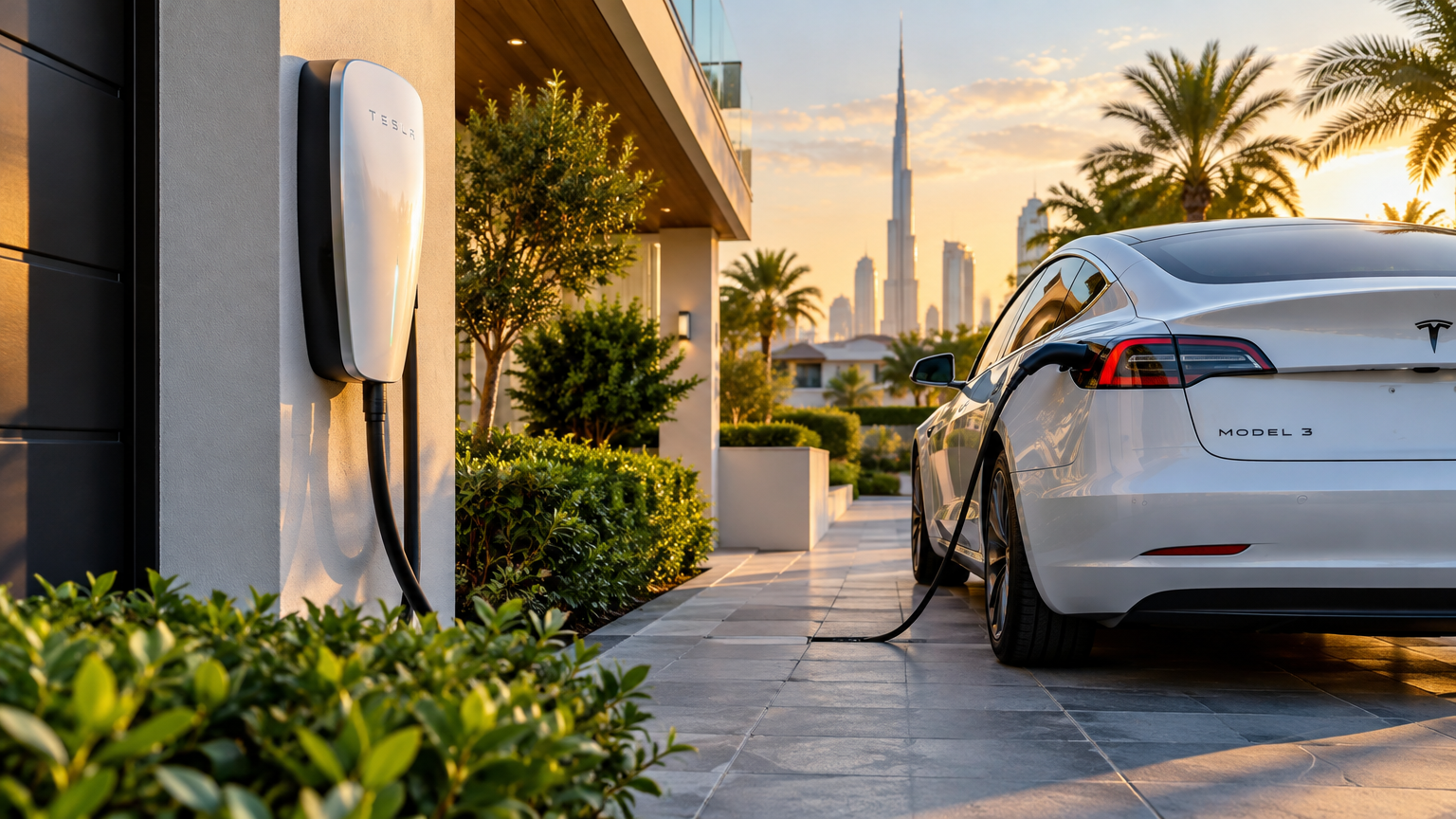
Installing EV charging in a Dubai townhouse requires navigating HOA approvals, DEWA permits, and practical electrical considerations. This guide walks you through the entire process—from checking your electrical capacity to selecting the right charger for communities like Arabian Ranches, Damac Hills, and Mudon—so you can make an informed decision about whether it’s feasible for your home.
Quick Summary
- HOAs and master developers (Emaar, DAMAC, Dubai Holding) typically require a No Objection Certificate (NOC) for electrical or external modifications; charging units fall under this requirement.
- DEWA permits are mandatory. You must comply with DEWA’s EV Charging Technical Regulations, including design standards, ambient conditions (up to 55°C), connector type, and approvals via DEWA-approved contractors.
- Installation costs vary significantly based on location (driveway vs. shared garage), power rating (7 kW, 11 kW, 22 kW), and whether electrical panel upgrades are needed—expect AED 2,500 to AED 9,000 for most cases, with higher costs for major upgrades.
- Popular brands include Wallbox, ABB, Tesla, and Autel. Look for weather resistance (IP-54 to IP-65), IEC 61851/DEWA compliance, load management, and high-temperature derating.
- If your HOA refuses, you can appeal with evidence of compliance, propose less visible designs, or explore alternatives like shared bays or portable chargers—though refusal may prevent permit approval.
Can You Legally and Practically Install EV Charging in Your Dubai Townhouse?
Understanding the rules and approvals
DEWA regulations and technical standards
DEWA’s EV Charging Technical Regulations (2025) require all private and public charging equipment (EVSE) in Dubai to meet specific design standards. Your charger must withstand UAE’s heat and humidity—ambient temperatures up to 55°C and up to 95% relative humidity—with proper connectors, circuits, and earthing. (dewa.gov.ae)
The Dubai Building Code Part G mandates prior DEWA approval for any private charging outlet. This isn’t optional—it’s a legal requirement for safety and grid stability. (beta.government.ae)
HOA and master developer requirements
Gated communities like Arabian Ranches, Mudon, and Damac Hills are managed by master developers with their own modification policies. Here’s what typically applies:
- Any external modifications—including driveway walls, parking structures, or external electrical fittings—require a NOC through the community portal. For Emaar communities (Arabian Ranches, Dubai Hills), this process is called “home modifications.” (cdn.properties.emaar.com)
- In Mudon and similar Dubai Holding communities, townhouse owners have private driveways but must still adhere to developer modification guidelines. (prod.dubaiholdingcommunities.ae)
Private driveway vs. shared garage considerations
Your installation process depends heavily on your parking setup:
- Private driveway or garage: If your townhouse has its own driveway or garage on your plot with your own DEWA meter and distribution board, approval is simpler. You’ll need DEWA approval plus a community NOC.
- Shared garage or parking area: If the charger goes in a shared garage, driveway, or common parking area, you need approval from both your HOA and potentially other residents. Electrical routing and safety become more complex, and costs rise significantly.
How to Choose the Right EV Charger for Your Townhouse
What to verify before starting
- Check your main breaker and electrical capacity: Many townhouses operate on single-phase power. Higher power chargers (like 22 kW) may require an upgrade to three-phase supply or distribution board changes.
- Assess cable routing and distance: Longer cable runs increase labour and material costs. Shared parking situations may require more invasive installation, potentially involving ceilings or common walls.
- Prioritize weather protection: Your charger must survive Dubai’s climate—intense sun, heat, and dust. Look for IP54/IP65 ratings and IK08/IK10 impact resistance. Ensure it’s certified for 55°C operation. (dewa.gov.ae)
- Verify connector and standards compliance: DEWA requires Type-2 connectors for public chargers, but private EVSE can be more flexible as long as it complies with IEC standards. Avoid extension cords and unsafe setups.
Popular brands and power rating options
These brands are widely available in Dubai with strong local support:
| Brand / Model | Power Rating | Supply Type | Heat Rating | Approx. Price (AED) |
|---|---|---|---|---|
| Wallbox Pulsar Plus | 7.4 kW / 22 kW | Single or three-phase | Full output to ~40°C, derated above (dubaismarthome.ae) | AED 2,100–3,700+ |
| ABB Terra AC | 22 kW | Three-phase | ~50°C, IP54 rating; excellent build quality (dubaismarthome.ae) | AED 6,400+ |
| Autel MaxiCharger AC | 22 kW | Three-phase | IP65, IK10, rated to 55°C (dubaismarthome.ae) | AED 2,450+ |
| Tesla Wall Connector | 7–22 kW | Single or three-phase | Lower IP rating; best installed in shaded areas (dubaismarthome.ae) | AED 2,300+ |
Choosing the right power level
- 7 kW single-phase: Ideal for light daily use (50–100 km/day), especially with overnight charging. This is the most affordable option.
- 11–22 kW three-phase: Better if you have multiple EVs, need faster charging, or already have three-phase power available.
- Cost-benefit note: Higher power units mean higher costs for cabling, distribution board upgrades, and DEWA approvals. Choose based on actual need.
Installation Costs: What to Budget in 2026
EV charging installation costs for townhouses vary based on several factors. Here’s what you can expect:
| Scenario | Budget Range (AED) | What’s Included |
|---|---|---|
| Private driveway, 7 kW single-phase | AED 2,500–6,000 | Charger unit, dedicated circuit, DEWA permit. Short cable run, no major panel upgrade. (chargerhouse.ae) |
| Shared garage, single-phase | AED 4,000–9,000 | HOA/management approvals, longer cable runs, possible trenching or routing through shared infrastructure. (chargerhouse.ae) |
| Higher power (11–22 kW), three-phase + upgrades | AED 6,000–15,000+ | Major electrical work, stronger circuit protection, possible DEWA supply increase. Costs vary with property access and existing infrastructure. (wattsergon.com) |
DEWA permits and approval timeline
- Permit fees: Typically AED 200–800 for straightforward installations. Complex cases involving load increases or shared buildings may cost more. (wattsergon.com)
- Approval timeline: Plan for 3–5 weeks from contractor survey to final DEWA approval in townhouse or shared parking situations. Simple, straightforward installations may take just 1–2 weeks. (fixerguy.ae)
What If Your HOA Refuses Permission?
Common reasons for denial
- Aesthetic concerns: Visible cables or fixtures that breach design guidelines.
- Electrical worries: HOA may claim shared electrical infrastructure cannot safely accommodate additional load, or that upgrades will be prohibitively expensive.
- Regulatory ambiguity: Older communities often lack defined procedures for EV charger approval.
How to appeal and escalate
- Demonstrate compliance: Present DEWA regulations, technical drawings, and safety certifications showing your installation meets all standards.
- Propose low-impact designs: Suggest wallboxes mounted in garages or shaded walls with concealed cable runs.
- Suggest community solutions: Rally neighbouring townhouse owners to petition for shared charging bays or common solutions.
- Understand the limits: DEWA approval doesn’t force HOA acceptance. Lack of HOA support can block installation, particularly in shared areas.
Keep in mind: Dubai’s leading residential communities increasingly market EV-ready infrastructure as a selling point. HOAs that consistently refuse without valid reason may face pressure as property values and buyer expectations shift.
Community-Specific Guidelines: Arabian Ranches, Damac Hills, Mudon
| Community | Typical Setup | NOC Requirements |
|---|---|---|
| Arabian Ranches (Emaar) | Most townhouses have private driveways and individual distribution boards | Emaar requires NOC for home modifications. External electrical work is included. Apply via the Home Modifications portal. (cdn.properties.emaar.com) |
| Damac Hills | Mix of private-garage townhouses and cluster garages | Likely requires both developer HOA NOC and DEWA compliance. Policies vary by subcommunity—contact management directly for specifics. |
| Mudon | Gated townhouse clusters with shared design standards | Community rules apply universally. Check with DHCM for alteration guidelines. NOC is typically required. (prod.dubaiholdingcommunities.ae) |
Step-by-Step Installation Process
- Site survey: Hire a DEWA-approved electrical contractor to assess your distribution board capacity, meter phase configuration, location options, and cable routing.
- Check HOA rules: Review your community’s modification requirements and submit a formal NOC request. Include technical drawings and charger specifications.
- Select your charger: Choose a unit that meets DEWA technical regulations for power rating, ambient temperature, and enclosure rating. Consider climate durability and future EV needs.
- Submit DEWA applications: File for Building No Objection Certificate—Electricity, electrical design approval, and dedicated circuit plans.
- Install equipment: Use a qualified contractor to install correct circuit protection, earthing, and safety components.
- Final inspection: Arrange DEWA site inspection and approval, plus community inspection if required. Obtain your Completion Certificate.
Frequently Asked Questions
Q: Do I need a specific “EV charger permit” from DEWA for a townhouse?
A: There’s no separate published “home EV charger permit,” but your installation must comply with DEWA’s technical regulations. Any significant electrical load change or new dedicated circuit requires Design Approval and electricity permits. (dubaismarthome.ae)
Q: What if my townhouse